
China is one of the world’s major manufacturing bases for Christmas ornaments and seasonal decorations, offering buyers access to a wide range of materials, designs, finishes and customization options.
But sourcing successfully involves much more than finding a product photograph and asking for the lowest price.
For importers, wholesalers, retailers and private-label brands, a successful Christmas decoration program depends on choosing the right manufacturer, preparing a clear product brief, approving samples carefully, planning production around the Christmas selling season and controlling quality before shipment.
This guide explains the practical steps B2B buyers should follow when sourcing Christmas decorations from China.
1. Define What You Want to Source Before Contacting Suppliers
Start with the product requirements rather than the supplier search.
A manufacturer can provide a much more useful quotation when you already know the basic direction of the collection.
Prepare information such as:
- Product category
- Reference images or drawings
- Approximate dimensions
- Materials, if specified
- Colors and finishes
- Quantity per design
- Number of SKUs
- Branding requirements
- Packaging requirements
- Target market
- Required delivery date
For example, there is a significant difference between:
“Please quote Christmas decorations.”
and:
“We are sourcing four Christmas bird designs in champagne and ivory, approximately 15 cm, with glitter and feather details. Initial quantity is 2,000 pieces per design with custom hangtags and retail packaging.”
The second inquiry allows the factory to evaluate materials, production methods, MOQ, sampling and packaging much more accurately.
2. Find a Manufacturer That Matches Your Product Category

Not every Christmas decoration factory specializes in the same products.
One manufacturer may be strong in Christmas balls, while another may have more experience with handcrafted birds, flowers, deer, tree toppers or decorative hanging ornaments.
When comparing potential suppliers, look for evidence that they have manufactured products similar to yours.
Useful evidence includes:
- Real factory photographs
- Production videos
- Similar product samples
- Current production
- Material and finish options
- Packaging examples
For customized programs, manufacturing experience is especially important.
A product involving hand painting, glitter, feathers or decorative assembly requires different production knowledge from a simple molded ornament.
The objective is not merely to find a supplier that sells Christmas decorations.
It is to find a manufacturer whose production capabilities match the collection you are developing.hoosing a Christmas decoration manufacturer in China
3. Verify the Manufacturer Before Placing a Large Order
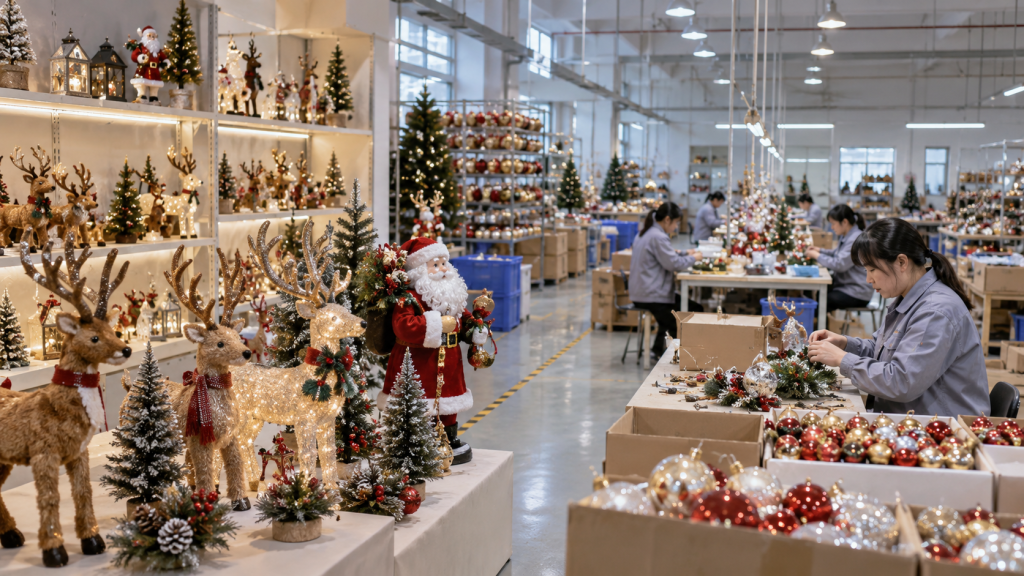
A professional sourcing process should include supplier verification.
Ask where production takes place and which processes are completed in-house.
You can request:
- Factory photographs
- Production videos
- Virtual factory tour
- Business information
- Sample products
- Quality-control information
For larger purchasing programs, buyers may also arrange an on-site or independent factory audit.
Pay particular attention to what you can actually see.
A showroom full of attractive products demonstrates product range, but a workshop showing painting, assembly, finishing, inspection and packing provides stronger evidence of manufacturing capability.
At REINDEER, we have manufactured Christmas decorations since 1998. Our production facility is approximately 20,000 sq. ft., with more than 200 skilled artisans supporting production during peak periods.
For B2B buyers, factory history matters most when it is supported by visible production experience.
4. Decide How Much Customization You Need
Not every sourcing project requires a completely new product.
There are broadly two routes.
Existing or Adapted Products
You may begin with an existing design and modify elements such as:
- Color
- Glitter
- Finish
- Accessories
- Branding
- Packaging
This can reduce product-development complexity.
Fully Custom Products
You may instead provide your own:
- Drawing
- Design concept
- Original shape
- Artwork
- Material requirements
- Construction requirements
The manufacturer then develops a new product around your brief.
This usually requires more sampling and may involve new tooling or specialized materials.
Before requesting quotations, decide where your project sits between these two approaches.
Doing so makes supplier comparisons much more meaningful.
how custom Christmas ornaments are made
5. Understand MOQ Before Finalizing the Collection
Minimum order quantity should be discussed early, particularly when your collection contains many designs and colors.Learn more in our Christmas Ornament MOQ Guide.
MOQ may depend on:
- Product construction
- Materials
- Number of colors
- Custom finishes
- Tooling
- Printing
- Packaging
- Production setup
Do not assume the MOQ applies only to the total purchase order.
A factory may have separate minimums per:
design, color, finish or packaging configuration.
For example, a 6,000-piece order divided across twelve SKUs may be more complicated to manufacture than a 6,000-piece order concentrated across three SKUs.
When requesting an MOQ, provide your proposed assortment rather than asking only:
“What is your minimum order quantity?”
This allows the manufacturer to suggest a more efficient order structure.
6. Use Sampling to Establish the Production Standard
Sampling is not simply a way to see whether the product looks attractive.
For customized Christmas decorations, the approved sample becomes an important production reference.
During sample review, check:
- Size
- Shape
- Materials
- Color
- Finish
- Painting
- Glitter
- Decorative positioning
- Assembly
- Hanging components
- Packaging fit
When revisions are required, consolidate comments and make them specific.
For example:
“Reduce gold glitter coverage by approximately one third and match the champagne color to the approved reference.”
is much clearer than:
“Please make it more premium.”
Once the final sample is approved, important specifications should also be recorded so the production team and QC staff have a clear standard.
For handcrafted ornaments, small natural variations may occur. The objective should be controlled consistency with the approved design rather than unrealistic mathematical uniformity.
7. Confirm Quality Control Before Production Starts
Quality should be planned before the goods are finished.
Ask the manufacturer how quality is controlled during:
Raw material preparation → production → assembly → finishing → final inspection → packaging
For decorative Christmas products, common inspection points may include:
- Color consistency
- Surface finish
- Painting
- Glitter application
- Decorative positioning
- Assembly
- Hanging parts
- Visible glue marks
- Scratches
- Packaging
In-process inspection is particularly useful because repeated problems can be corrected before the entire order is completed.
For larger orders, buyers may also arrange an independent pre-shipment inspection.
The most useful question is often:
“How will bulk production be compared with the approved sample?”
A reliable manufacturer should be able to explain the answer clearly.
8. Plan Retail and Export Packaging Early
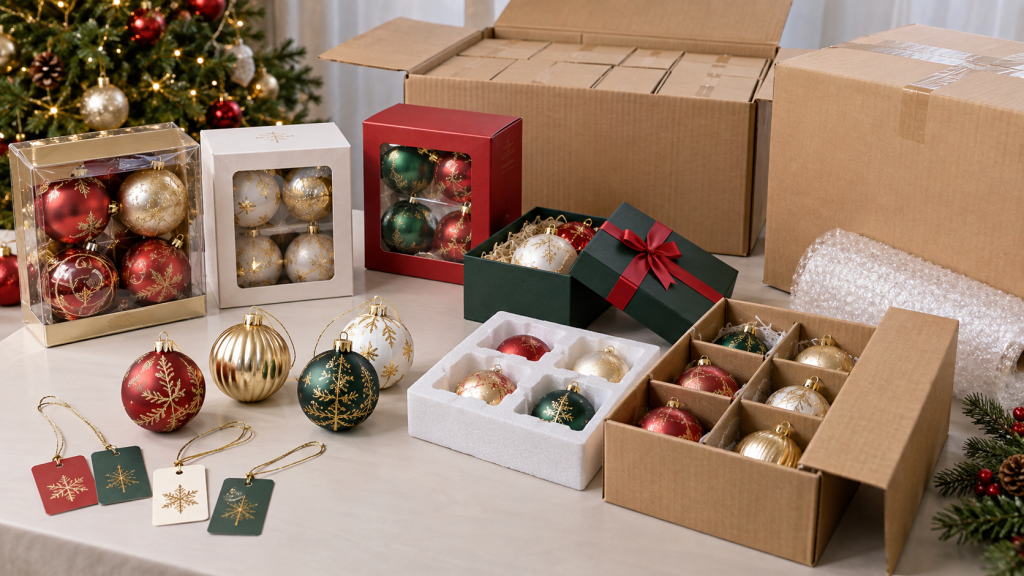
Packaging is part of the sourcing project, not something to decide after production.
Christmas decorations may require both attractive retail presentation and protection during international transportation.
Retail options can include:
- Hangtags
- Window boxes
- Color boxes
- Gift boxes
- Private-label packaging
- Barcode labels
Export packaging may involve:
- Protective inserts
- Dividers
- Inner cartons
- Master cartons
Buyers should request packing data such as:
pieces per carton, carton dimensions and gross weight.
These figures affect freight cost and container utilization.
For fragile or complex products, packaging should be reviewed during the sample-development stage.
A low product price can quickly lose its advantage if inefficient packaging increases freight costs or fails to protect the goods.
9. Plan Backward From Your Required Arrival Date
Christmas merchandise has a fixed selling season.
This makes scheduling one of the most important parts of the sourcing process.
Do not ask only:
“How many days is production?”
Instead, plan backward:
Warehouse Arrival
↓
International Transportation
↓
Final Inspection
↓
Packing
↓
Bulk Production
↓
Sample Approval
↓
Product Development
Build additional time into custom programs for sample revisions and packaging approval.
Factory capacity can also become more limited as seasonal production becomes busier.
The safest approach is to tell the manufacturer your required warehouse or retail date at the beginning of the project and develop the production schedule around it.
10. Compare Total Sourcing Value, Not Only Unit Price
When comparing suppliers, unit price matters—but it should not be the only factor.
Consider:
- Product quality
- Sampling efficiency
- MOQ
- Packaging
- Communication
- Production capacity
- Quality control
- Delivery reliability
- Freight efficiency
A slightly lower unit price may not create savings if it leads to repeated sample revisions, poor packaging, higher defects or delayed shipment.
For seasonal merchandise in particular, missing the selling window can create a much larger loss than a small difference in FOB price.
A useful supplier comparison therefore considers:
Product Cost + Development + Quality + Packaging + Delivery Risk
rather than price alone.
11. Confirm Import Requirements for Your Destination Market
Import requirements depend on where the goods will be sold and on the product itself.
Before production, buyers should confirm:
- Product classification
- Applicable duties
- Import documentation
- Product requirements
- Labeling requirements
- Testing requirements, where applicable
Do not assume every Christmas decoration is subject to the same rules.
Requirements can vary depending on materials, construction, intended use and destination market.
For unfamiliar products or markets, work with your customs broker, freight forwarder or relevant regulatory specialist to confirm the requirements before shipment.
This is particularly important for customized programs because product materials or construction may differ from earlier orders.
12. Start With a Clear RFQ
A good RFQ saves time for both the buyer and manufacturer.
For an initial Christmas decoration sourcing request, provide:
| Information | Example |
|---|---|
| Product | Christmas bird ornament |
| Size | Approx. 15 cm |
| Colors | Champagne and ivory |
| Quantity | 2,000 pcs per design |
| Number of Designs | 4 |
| Customization | Glitter, feather and private-label hangtag |
| Packaging | Retail-ready box |
| Market | United States |
| Delivery | Required warehouse date |
| Reference | Drawing or product image |
The manufacturer can then respond with more useful information about feasibility, sampling, MOQ, price and lead time.
This is much more efficient than asking for a price before defining the product.
A Practical China Sourcing Checklist
Before placing a Christmas decoration order in China, confirm five areas:
Product: The design, size, material, color and finish are defined.
Supplier: The manufacturer has relevant production capability.
Sample: The final product standard has been approved.
Commercial: MOQ, price, packaging and production timing are confirmed.
Quality & Delivery: Inspection requirements and shipment schedule are documented.
If any of these areas remain unclear, resolve them before mass production begins.
Sourcing Christmas Decorations With REINDEER
REINDEER has manufactured Christmas decorations since 1998, combining traditional craftsmanship with organized production methods.
We work with B2B buyers across product development, sampling, bulk production, quality inspection and packaging.
Depending on the project, buyers may begin with an existing product, a reference image or an original design.
Our goal is to help determine whether the concept can be manufactured consistently and then establish a clear production standard before bulk manufacturing begins.
For buyers sourcing Christmas decorations from China, the most useful first step is to send:
your product reference + quantity per design + customization requirements + packaging requirements + target delivery date.
From there, the project can be evaluated on actual manufacturing requirements rather than assumptions.
Frequently Asked Questions
How do I find a reliable Christmas decoration manufacturer in China?
Look for a supplier with experience in your specific product category, visible manufacturing evidence, a structured sampling process, quality-control procedures and realistic production planning. For larger programs, consider additional supplier verification or factory audits.
What information should I send when sourcing Christmas decorations from China?
Send product references or drawings, dimensions, colors, quantity per design, customization requirements, packaging needs, target market and required delivery date.
Can I order custom Christmas decorations from China?
Yes. Depending on the manufacturer, customization can include colors, shapes, materials, finishes, logos, hangtags and retail packaging. Fully custom designs generally require additional sampling and development.
How early should I place Christmas decoration orders?
Plan backward from your required warehouse or retail date. Allow enough time for sampling, revisions, bulk production, inspection, packing and international transportation. Custom products usually require more preparation than existing designs.
Should I choose the supplier with the lowest price?
Not automatically. Compare product quality, development capability, MOQ, packaging, communication, production capacity and delivery reliability in addition to unit price.
Final Thoughts
Successful Christmas decoration sourcing from China is not mainly about finding the largest catalog or the lowest quotation.
It is about building a controlled process:
Clear Brief → Right Manufacturer → Approved Sample → Controlled Production → QC → Packaging → On-Time Shipment
When buyers define the product clearly and address quality, packaging and timing before production begins, sourcing becomes much easier to manage.
If you are developing a wholesale, retail or private-label Christmas collection, send REINDEER your product references, target quantities, customization requirements, packaging needs and required delivery date.
We can review the project and discuss the most practical route from sampling to bulk production.