For wholesalers, importers, retailers and private-label brands, finding a Christmas ornament manufacturer is easy.
Finding one that can reliably reproduce an approved design across thousands of pieces, maintain quality during peak season and deliver before the Christmas selling window is much harder.
That difference matters.
A supplier may produce an excellent showroom sample but struggle with color consistency during mass production. Another may offer a competitive quotation but lack sufficient capacity when seasonal orders increase. Packaging that looks acceptable during sampling may also prove inadequate after international transportation.
For professional buyers, supplier selection should therefore go beyond price and product photographs.
A reliable Christmas ornament manufacturer should demonstrate consistency across product development, mass production, quality control, packaging and delivery.
Here are the most important areas B2B buyers should evaluate before placing a wholesale order.
1. Look for Relevant Christmas Ornament Manufacturing Experience
Start with experience in the actual products you plan to source.
Products such as Christmas bird ornaments may require experience with feathers, clips, lightweight structures and decorative assembly.
Christmas ornaments can involve very different materials and manufacturing techniques, including:
- Glass
- Plastic
- Foam
- Paper
- Fabric
- Metal
- Feathers
- Glitter
- Beads
- Sequins
- Hand painting
- Decorative assembly
For example, buyers sourcing Christmas ball ornaments should evaluate experience with the specific materials, finishes and assembly methods used for that category.
A factory experienced with one type of seasonal product may not automatically be skilled in another.
Ask prospective suppliers:
- How long have you manufactured Christmas decorations?
- Which Christmas ornament categories are your strongest?
- Which processes are completed in-house?
- Have you produced similar designs before?
- Can you show current production rather than only catalog photographs?
Relevant experience matters because decorative products often involve manual processes that are difficult to standardize without trained workers and clear quality standards.
Experience should be visible
Years in business alone are not enough.
Look for evidence such as:
- Production photographs
- Factory videos
- Sample archives
- Material boards
- Packaging examples
- Quality inspection records
- Similar product categories
At REINDEER, Christmas decoration production dates back to 1998.
Our manufacturing facility has grown to approximately 20,000 sq. ft., with more than 200 skilled artisans supporting production during peak periods.
This experience is particularly valuable in products that rely on hand painting, glitter application, assembly, finishing and other craft-based processes.
2. Verify the Factory Behind the Quotation
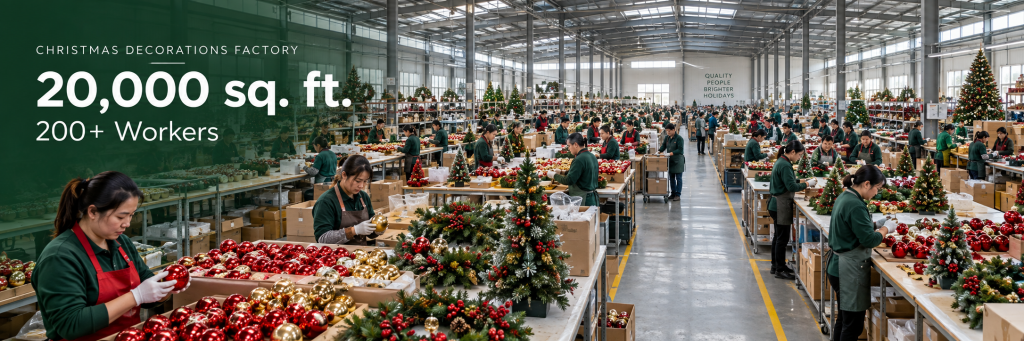
A professional buyer should understand who actually manufactures the products.
Some suppliers own or operate production facilities.
Others coordinate orders through subcontractors.
Both models can work, but buyers should know which model they are dealing with because it affects communication, quality control, capacity and traceability.
Before placing a significant wholesale order, request:
- Factory exterior photographs
- Workshop photographs
- Current production images
- Production videos
- Virtual factory tour
- Business documentation when appropriate
You can also ask a simple but useful question:
“Which production steps for my product will be completed inside your facility?”
A transparent supplier should be able to answer clearly.
3. Check Whether Bulk Production Can Match the Approved Sample
This is one of the biggest risks in decorative product sourcing.
An attractive sample does not automatically guarantee consistent mass production.
Christmas ornaments may involve variation in:
- Color
- Glitter coverage
- Painting
- Fabric positioning
- Decorative details
- Surface finish
- Assembly
- Hanging components
Before approving a supplier, ask how the factory controls the transition from sample to bulk production.
A reliable process should establish an approved reference sample and clearly record important specifications such as:
- Dimensions
- Pantone or color reference
- Materials
- Surface treatment
- Artwork
- Decoration positioning
- Accessories
- Packaging
The approved sample should then become the visual and technical reference for mass production.
For custom orders, buyers may also request a pre-production sample before the complete order enters production.
4. Understand the MOQ Structure
Wholesale buyers frequently compare suppliers based on minimum order quantity.
However, MOQ should not be evaluated without understanding what creates it.
The minimum quantity may depend on:
- Material purchase requirements
- Number of colors
- Number of designs
- Custom molds
- Printing
- Handwork
- Packaging
- Production efficiency
An existing product may support a lower MOQ than a fully customized ornament.
At REINDEER, for example, current standard-product MOQ is typically around 500 pieces per design, while custom designs generally require higher quantities depending on the product and customization.
For buyers developing a complete seasonal collection, it is also worth asking:
Can different colors or coordinated designs be combined within the order?
This can help retailers test a broader assortment without committing excessive inventory to one SKU.
5. Evaluate OEM and Custom Development Capability
For private-label brands and retailers, the ability to develop new products is often more important than the size of a supplier’s existing catalog.
A capable custom Christmas ornament manufacturer should be able to support some combination of:
- Buyer-supplied concepts
- Reference images
- Sketches
- New colors
- Custom sizes
- New shapes(This becomes particularly important for structural products such as Christmas tree topper stars, where size, weight, balance and attachment design all influence the finished product.)
- Glitter treatments
- Hand-painted details
- Decorative accessories
- Custom logos
- Hangtags
- Private labels
- Retail packaging
Ask how the product development process works.
A typical workflow may look like:
Buyer Brief → Feasibility Review → Quotation → Prototype → Revision → Sample Approval → Production → Inspection → Packaging → Shipment
The development stage should identify technical issues before mass production.
For example, a decoration that looks attractive in a drawing may be too heavy to hang properly, too fragile for shipping or too complex to reproduce consistently.
An experienced manufacturer should identify these risks during development rather than after production begins.
6. Test the Supplier Through Sampling
Sampling is one of the most useful supplier-evaluation stages.
Do not evaluate only whether the sample looks attractive.
Also evaluate how the supplier manages the process.
Consider:
- Did the supplier understand your brief?
- Were materials correctly interpreted?
- Was the target color followed?
- Were dimensions accurate?
- Were requested changes recorded?
- Was communication clear during revisions?
- Did the supplier explain technical limitations?
- Was packaging considered early?
A manufacturer that handles sampling carefully is generally easier to work with during mass production.
Conversely, repeated misunderstandings during a small sample project can become much more expensive once thousands of units are involved.
7. Review the Quality Control Process
Wholesale Christmas ornament orders need quality control at more than one stage.
A strong QC system should prevent defects rather than simply discover them after production.
Raw material inspection
Materials and components should be checked against approved requirements before production.
In-process inspection
Quality checks during painting, glittering, assembly and finishing help stop repeated defects early.
Appearance inspection
Depending on the product, inspectors may evaluate:
- Color
- Painting
- Glitter
- Surface finish
- Scratches
- Glue marks
- Decorative positioning
- Shape
- General workmanship
Assembly inspection
Attached components should be checked for stability and correct positioning.
For hanging ornaments, cords, clips, caps or wires should also be reviewed.
Final inspection
Finished goods should be compared with the approved specifications before packing or shipment.
For larger wholesale programs, buyers may also arrange independent pre-shipment inspection.
8. Check Product Compliance for Your Destination Market
A supplier should know that product requirements depend on where and how the merchandise will be sold.
However, buyers should not rely solely on a supplier saying:
“Our products are compliant.”
Instead, identify the applicable requirements for the actual product and market.
Consider:
- Product materials
- Coatings
- Intended use
- Target country
- Retailer-specific standards
- Age grading where applicable
Buyers importing regulated consumer products into the United States should review the applicable requirements published by the U.S. Consumer Product Safety Commission (CPSC).
Buyers selling into the EU should also determine whether relevant REACH requirements apply to the materials and substances in their products.
Testing requirements should be discussed early enough to avoid delaying shipment.
9. Examine Packaging Before You Examine the Final Price
Packaging can significantly affect the true cost of a wholesale Christmas ornament order.
This is especially true for products with:
- Delicate surfaces
- Glitter finishes
- Glass components
- Feathers
- Projecting decorations
- Complex shapes
Ask the supplier to explain both retail and export packaging.
Retail options may include:
- Window boxes
- Gift boxes
- Color boxes
- Hangtags
- Labels
- Barcode packaging
- Display-ready packaging
Transport packaging may include:
- Protective inserts
- Dividers
- Inner cartons
- Master cartons
- Protective wrapping
Also request:
- Pieces per carton
- Carton dimensions
- Gross weight
- Net weight
These figures affect freight planning and landed cost.
A cheaper unit price can become less attractive if inefficient packaging significantly increases shipping volume.
10. Evaluate Production Capacity During Peak Season
Christmas products have a fixed commercial deadline.
A factory delivering two months late cannot compensate for that delay by offering a small price discount.
Ask prospective manufacturers:
- What is your normal lead time?
- What changes during peak season?
- How much production capacity is available for my order?
- When should sampling be completed?
- When should packaging be approved?
- When must the PO be confirmed to meet my shipping date?
At REINDEER, seasonal production planning is important because our workforce can expand to more than 200 skilled artisans during peak production periods.
Buyers should still confirm timing based on the actual order rather than relying on a generic lead-time promise.
For custom projects, build a timeline backward:
Required Warehouse Date
↓
International Shipping
↓
Final Inspection
↓
Packing
↓
Mass Production
↓
Pre-production Approval
↓
Sampling
↓
Design Finalization
This approach makes schedule risks much easier to identify.
11. Judge Communication Before You Place the Purchase Order
Supplier communication is often underestimated.
During quotation and sampling, notice whether the supplier:
- Answers technical questions clearly
- Requests missing information
- Confirms changes in writing
- Identifies possible production risks
- Provides realistic timelines
- Shares progress when required
For OEM projects, a supplier should not simply say yes to every request.
Sometimes the most valuable response is:
“This construction may create a production or shipping problem. Here is an alternative.”
That demonstrates manufacturing knowledge rather than simple salesmanship.
12. Compare Total Landed Risk, Not Only FOB Price
Wholesale sourcing decisions often begin with a spreadsheet comparing unit prices.
That spreadsheet should include more than FOB cost.
Consider possible costs associated with:
- Defects
- Rework
- Sample revisions
- Packaging failure
- Shipping damage
- Inspection failure
- Delays
- Emergency freight
- Missed seasonal sales
Suppose Supplier A is slightly cheaper than Supplier B.
If Supplier A causes repeated sample revisions, poor carton utilization and higher defect rates, Supplier A may ultimately cost substantially more.
A reliable Christmas ornament manufacturer should therefore be evaluated according to:
Product Cost + Quality + Development + Packaging + Reliability + Delivery Risk
not simply:
Lowest Unit Price
13. Ask for Packaging and Shipping Data Before the Order
Experienced wholesale buyers often evaluate carton information while negotiating the product—not after production.
Ask for estimated:
- Packing quantity
- Carton size
- Carton weight
- Packaging materials
- Shipment volume
This information helps buyers estimate:
- Container utilization
- LCL or FCL requirements
- Freight cost
- Warehouse space
- Distribution requirements
For fragile Christmas ornaments, buyers should also discuss how the packaging has been designed to prevent movement or surface damage during transportation.
14. Assess Whether the Manufacturer Can Grow With Your Business
A supplier that works for a first trial order may not necessarily be right for a growing retail program.
Consider what happens if:
- Your quantity doubles
- You add 20 new SKUs
- You require custom packaging
- You expand into another country
- You introduce a private-label collection
- Your retailer requires additional documentation
A long-term manufacturing partner should have enough flexibility to support increasing complexity.
This is particularly important for wholesalers and brands that expand seasonal collections year after year.
15. Watch for Common Supplier Red Flags
No single warning sign automatically proves a supplier is unreliable.
However, several issues together deserve attention.
Potential warning signs include:
- Extremely vague factory information
- Reluctance to show production areas
- Quotations with unclear specifications
- Unusually low pricing without explanation
- No clear sample approval process
- No defined quality standard
- Constant changes in stated lead time
- Poor documentation of revisions
- Packaging discussed only after production
- Promising every request without technical review
The goal is not to find a supplier that never encounters problems.
Manufacturing problems can happen.
The more important question is whether the supplier has systems to identify, communicate and correct problems before they affect the complete order.
Christmas Ornament Manufacturer Evaluation Checklist
Before placing a wholesale order, score potential suppliers across these areas:
| Evaluation Area | Questions to Ask |
|---|---|
| Factory Experience | How long have you manufactured Christmas decorations? |
| Product Capability | Have you produced ornaments similar to ours? |
| Manufacturing | Which processes are completed in-house? |
| MOQ | What determines MOQ for this specific product? |
| Sampling | How are prototypes and revisions managed? |
| OEM / ODM | Can you develop custom designs and private-label programs? |
| Quality Control | Which inspections happen during production? |
| Bulk Consistency | How do you compare production with the approved sample? |
| Compliance | What documentation or testing can be supported for our market? |
| Packaging | Can you provide retail-ready and export packaging? |
| Production Capacity | Can our quantity be completed within the required season? |
| Lead Time | What is the realistic production schedule? |
| Communication | Who manages the project after the PO is placed? |
| Shipping Data | Can you provide carton size, quantity and weight? |
You can also create an internal supplier scorecard and assign greater weight to the factors that matter most to your business.
Why Wholesale Buyers Work With REINDEER
REINDEER has been manufacturing Christmas decorations since 1998.
From a small workshop, we have developed into an approximately 20,000 sq. ft. manufacturing facility combining skilled handcraftsmanship with organized production processes.
During peak season, more than 200 artisans support production across processes including:
- Hand finishing
- Painting
- Assembly
- Stringing
- Drying
- Inspection
- Packaging
- Labeling
For our wholesale and private-label partners, our role extends beyond producing an existing item.
We work with buyers through product development, sampling, manufacturing, quality inspection and customized packaging.
This allows buyers to build Christmas ornament collections that are designed not only to look good as samples but also to be practical for repeatable commercial production.
Final Thoughts
Choosing a reliable Christmas ornament manufacturer requires more than finding a supplier with an attractive catalog.
Wholesale buyers should evaluate:
- Relevant manufacturing experience
- Factory transparency
- Sample-to-bulk consistency
- MOQ
- OEM development
- Sampling
- Quality control
- Compliance
- Packaging
- Production capacity
- Communication
- Delivery performance
The right supplier should reduce uncertainty throughout the entire purchasing process.
Before issuing your next Christmas ornament PO, give potential manufacturers the same product brief and compare not only the prices they return, but also the questions they ask, the evidence they provide and the systems they use to protect quality and delivery.
If you are developing a wholesale Christmas ornament program, send REINDEER your product reference, target quantity, required delivery date and packaging requirements.
Our team can review your project and advise on sampling, manufacturing and packaging options before bulk production begins.
Frequently Asked Questions
What should I look for in a Christmas ornament manufacturer?
Look for relevant product experience, transparent factory information, customization capability, a structured sampling process, quality control, suitable packaging and realistic production capacity. For wholesale orders, also check whether the supplier can maintain consistency between approved samples and mass production.
How can I verify a Christmas ornament factory?
Request production photographs, factory videos, business information and a virtual or physical factory tour. For larger orders, buyers may also use independent factory audits or third-party inspections.
What is a typical MOQ for wholesale Christmas ornaments?
MOQ depends on the product, materials, colors, production process and packaging. Existing products usually allow more flexible quantities than fully customized designs. Always request an MOQ for the exact SKU and packaging configuration rather than relying on a general factory minimum.
Should I choose the cheapest Christmas ornament supplier?
Not necessarily. Compare total sourcing value, including quality, packaging, sample revisions, production reliability and delivery risk. A lower unit price may create higher overall costs if it leads to defects, shipping damage or missed seasonal deadlines.
Can Christmas ornament manufacturers create custom designs?
Many manufacturers provide OEM or ODM services covering colors, shapes, finishes, decorative details, branding and packaging. Buyers should confirm the supplier’s actual development capabilities and sampling process before placing a bulk order.
How do I make sure bulk Christmas ornaments match my sample?
Create an approved master sample and confirm specifications such as dimensions, colors, materials, artwork, finish and packaging. For custom programs, consider approving a pre-production sample before complete mass production.
When should wholesalers order Christmas ornaments?
Work backward from your required warehouse or retail launch date. Allow sufficient time for design development, sampling, revisions, production, inspection, packaging and international transportation. Earlier planning is especially important as factory capacity becomes tighter during seasonal peaks.