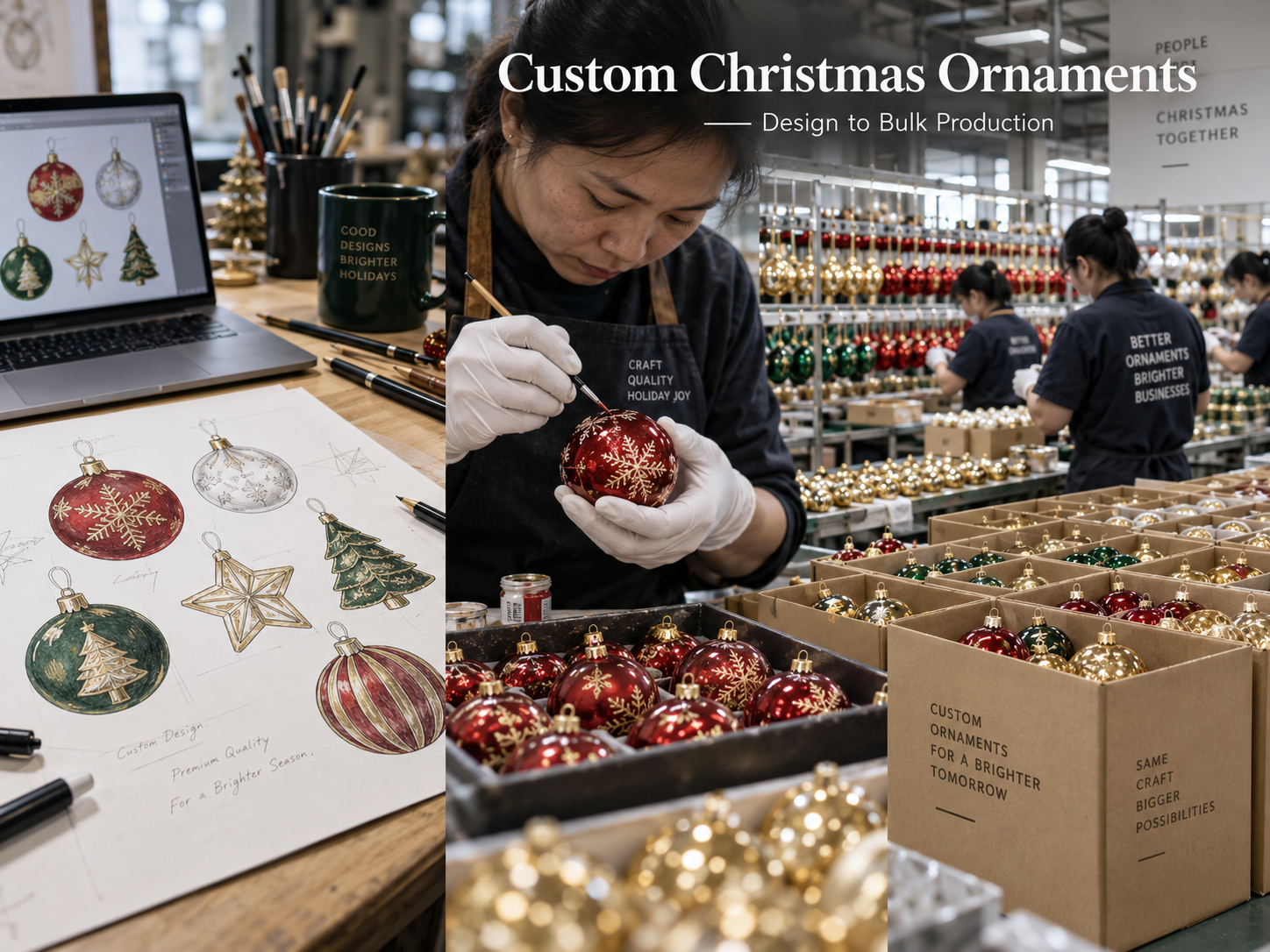
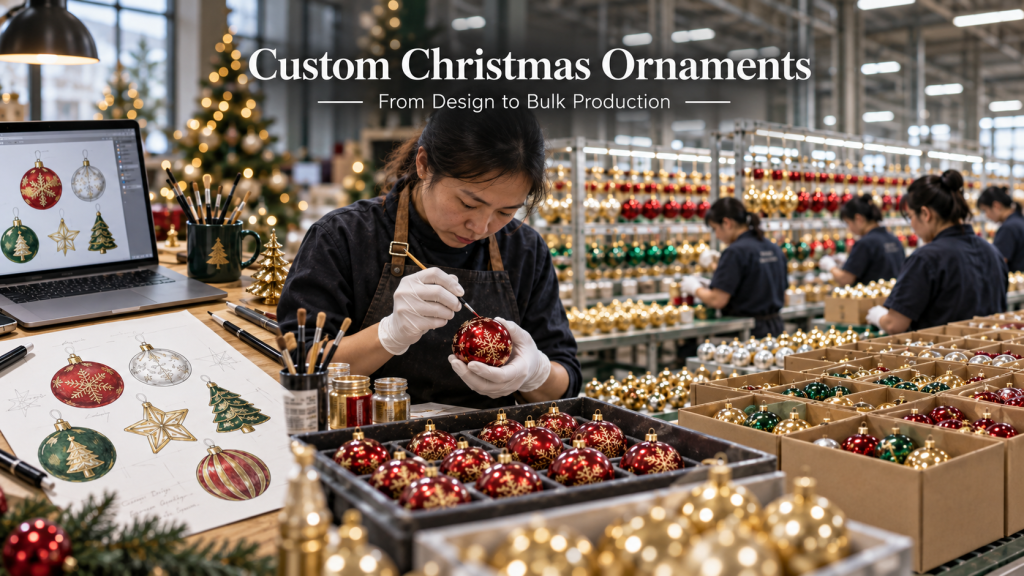
A custom Christmas ornament may begin with something as simple as a sketch, reference image, color palette or mood board.
Turning that idea into thousands of consistent, retail-ready pieces is a very different challenge.
For importers, wholesalers, retailers and private-label brands, understanding how custom Christmas ornaments are made can make product development much easier.Buyers who are still evaluating suppliers can first review our guide to choosing a Christmas decoration manufacturer in China.
It helps buyers prepare clearer RFQs, reduce unnecessary sample revisions, identify production risks earlier and establish realistic timelines for seasonal programs.
Although the exact manufacturing process varies according to the material and design, most custom Christmas decoration projects follow a similar path:
Buyer Brief → Feasibility Review → Quotation → Material & Color Selection → Sampling → Sample Approval → Pre-Production Preparation → Bulk Production → Quality Control → Packaging → Shipment
Let’s look at each stage in more detail.
1. The Process Starts With a Clear Buyer Brief
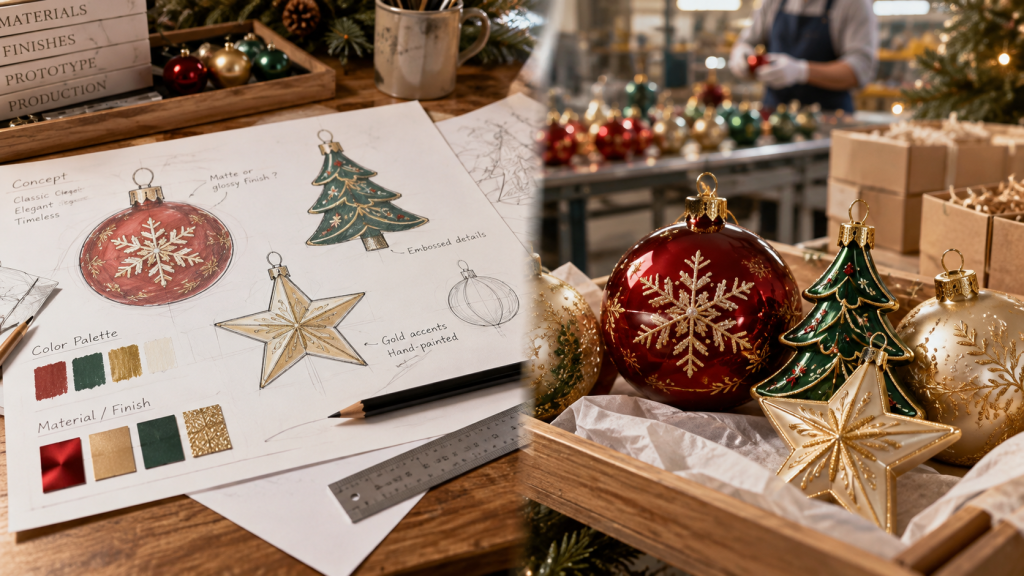
Before a factory can make an accurate sample or quotation, it needs to understand what the buyer wants to develop.
A useful custom Christmas ornament brief normally includes:
- Product type
- Reference image or sketch
- Dimensions
- Target colors
- Materials
- Surface finish
- Decorative details
- Estimated quantity
- Target market
- Target price range, if available
- Branding requirements
- Packaging requirements
- Required delivery date
For example, a request saying:
“We need a custom Christmas bird ornament.”
still leaves many questions unanswered.
A stronger brief might specify:
“We are developing a 15 cm hanging Christmas bird ornament in champagne and gold, with feathers, glitter details and a clip attachment. Initial quantity is 3,000 pieces per design, packed in a private-label retail box for the European market.”
The second version gives the development team much more information to work with.
Inspiration is not the same as a specification
Reference photographs and mood boards are extremely useful, but buyers should explain which elements are essential.
For example:
Must keep:
- Champagne color palette
- Feather tail
- Gold glitter details
- 15 cm approximate length
Open to factory suggestions:
- Body material
- Clip construction
- Glitter application method
- Packaging structure
This gives the manufacturer enough creative and technical flexibility to make the design practical for commercial production.
2. The Factory Reviews Manufacturing Feasibility
Before sampling begins, the manufacturer should review whether the concept can be reproduced reliably at scale.
This is where manufacturing experience becomes important.Manufacturing capability is also one of the key factors buyers should evaluate when choosing a reliable Christmas ornament manufacturer.
A design may look attractive in a drawing but create problems when converted into a physical product.
Potential issues include:
- Decorations that are too heavy
- Fragile projecting parts
- Poor hanging balance
- Difficult assembly
- Unstable glitter adhesion
- Colors that are difficult to reproduce consistently
- Excessive handwork
- Packaging that requires too much space
- Materials that do not suit the target cost
A good manufacturer does not simply say “yes” to every idea.
The factory should identify potential problems and suggest practical alternatives when necessary.
For example, if a decorative element is too heavy for a hanging ornament, the development team may recommend a lighter material or a different attachment method.
If a very complex hand-painted pattern creates excessive variation in mass production, the artwork may need to be simplified while retaining the original visual concept.
The objective is not to reduce creativity.
It is to create a product that can be manufactured repeatedly and consistently.
3. Materials and Production Techniques Are Selected
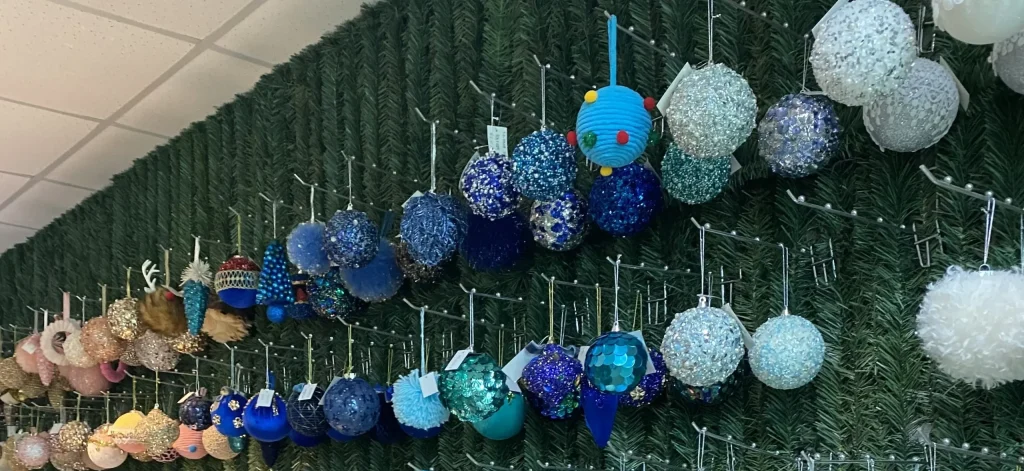
For products such as Christmas ball ornaments, material choice can substantially affect weight, breakage resistance, finishing options and packaging.
Once the concept is considered feasible, the next step is to determine how the ornament will actually be made.
Christmas decorations can combine many different materials, including:
- Plastic
- Glass
- Foam
- Paper
- Fabric
- Metal
- Wood
- Feathers
- Artificial foliage
- Beads
- Sequins
- Glitter
- Ribbon
- Wire
- Decorative trims
The selected material affects:
- Appearance
- Weight
- Cost
- Durability
- Production process
- Packaging
- MOQ
The same design can sometimes be produced using different constructions.
For example, a lightweight hanging ornament may use foam or plastic as the internal structure, while a premium decorative version may use additional hand-applied details, feathers, beads or fabric.
The manufacturer and buyer should agree on the construction before finalizing the sample.
4. Colors and Finishes Are Defined
Color is especially important in seasonal collections.
A buyer may be developing an entire range around:
- Classic red and green
- Champagne gold
- Silver and white
- Burgundy
- Pastel Christmas colors
- Natural woodland tones
- Vintage metallic finishes
Whenever exact color matching matters, buyers should provide a reliable reference.
Depending on the project, this may include:
- Pantone references
- Color chips
- Material swatches
- Approved physical samples
The finish must also be defined.
Examples include:
- Matte
- Glossy
- Metallic
- Glitter
- Frosted
- Hand-painted
- Iridescent
- Sequin
- Flocked
- Distressed
- Textured
Two products with the same base color can look completely different depending on their surface treatment.
For this reason, both color and finish should be approved during sampling.
5. The First Sample Is Developed
Once the design direction, materials and basic specifications are clear, sample development can begin.
This is where the digital or visual concept becomes a physical object for the first time.
Depending on the product, sampling may involve:
- Forming the basic structure
- Cutting materials
- Painting
- Glitter application
- Hand decoration
- Assembly
- Adding feathers or trims
- Installing hanging cords or clips
- Adding accessories
- Preparing preliminary packaging
The first sample should be considered a development sample rather than automatically treated as the final production standard.
Its purpose is to answer questions such as:
- Is the size correct?
- Is the proportion attractive?
- Does the ornament hang correctly?
- Are the colors right?
- Is the finish suitable?
- Are decorative elements positioned correctly?
- Is the product stable?
- Can it be manufactured efficiently?
- Will it fit the intended packaging?
This stage is one of the most important parts of custom Christmas ornament development.
6. Buyers Review and Revise the Sample
It is normal for custom products to require revisions.
The important point is to manage those revisions clearly.
Instead of sending comments one at a time, buyers should ideally consolidate feedback into a structured sample review.
A useful review may include:
| Item | Sample Result | Required Change |
|---|---|---|
| Overall size | Approved | None |
| Main color | Too dark | Match approved champagne reference |
| Glitter | Too heavy | Reduce coverage |
| Feather tail | Too short | Increase by 2 cm |
| Hanging loop | Approved | None |
| Packaging | Pending | Develop after product approval |
Photographs with annotations are particularly helpful.
For example:
“Move this decoration 5 mm upward.”
is much clearer than:
“The decoration looks slightly wrong.”
Clear revision records also reduce the risk of an older instruction being used accidentally during later sampling.
7. The Approved Sample Becomes the Production Reference
Once the buyer approves the product, the final sample should become a reference for mass production.
Important specifications should also be documented separately.
These may include:
- Overall dimensions
- Materials
- Color references
- Finish
- Decorative positioning
- Artwork
- Logos
- Accessories
- Hanging components
- Packaging specifications
This creates a clearer standard for factory production and quality inspection.
For products involving substantial handwork, buyers should also understand that handmade details may show small natural variations.
The objective of quality control is not necessarily to make every handcrafted product mathematically identical.
It is to establish an acceptable visual range so the complete order remains consistent with the approved design.
8. Pre-Production Preparation Begins
Before bulk manufacturing starts, the factory needs to prepare:
- Raw materials
- Decorative components
- Color references
- Packaging materials
- Production instructions
- Approved samples
- Artwork files
- Labels
- Carton markings
For customized projects, this stage can prevent expensive mistakes later.
Imagine discovering after 5,000 units have been completed that a private-label hangtag contains the wrong barcode.
Or finding that an inner box is too small after all packaging has already been printed.
Pre-production checking is designed to catch these issues before large quantities are affected.
For larger or more complex projects, buyers may request a pre-production sample using final production-intent materials and packaging.
9. Bulk Production Starts
Once the production standard is confirmed, manufacturing can begin.
The exact sequence depends on the ornament.
For many handcrafted Christmas decorations, production may include several specialized stations.
At REINDEER, these can include processes such as:
Base Preparation
↓
Painting
↓
Decorative Finishing
↓
Glitter Application
↓
Assembly
↓
Stringing or Attachment
↓
Drying
↓
Inspection
↓
Packaging
Some products require only a few of these processes.
Others may pass through multiple workers before they are complete.
Why skilled handwork still matters
Modern production methods improve organization and repeatability, but many Christmas decorations still rely heavily on craftsmanship.
Hand-applied glitter, painted details, feathers, bows, beads and decorative assembly often require experienced workers.
This is one reason manufacturing experience matters for custom seasonal products.
REINDEER has manufactured Christmas decorations since 1998, combining traditional handcraftsmanship with organized production methods.
During peak production periods, more than 200 skilled artisans support manufacturing in our approximately 20,000 sq. ft. facility.
The objective is to maintain the handmade character buyers want while still achieving the consistency required for commercial-scale orders.
10. Quality Control Takes Place During Production
Quality inspection should not wait until every ornament has already been finished.
Checking production during manufacturing makes it possible to identify recurring problems earlier.
Depending on the design, in-process inspection may review:
- Overall dimensions
- Colors
- Painting
- Glitter coverage
- Decorative placement
- Assembly
- Adhesive marks
- Scratches
- Surface finish
- Hanging components
- Balance
If a problem begins appearing repeatedly, production can be corrected before it affects the complete order.
For example, if glitter coverage gradually becomes heavier than the approved sample, identifying the issue after the first production batch is much better than identifying it after thousands of pieces are packed.
11. Finished Ornaments Receive Final Inspection
After manufacturing is complete, finished ornaments should be checked again.
Final inspection may include:
Appearance
Does the product visually match the approved standard?
Dimensions
Are size and proportions within the agreed range?
Assembly
Are attached decorations secure?
Hanging or Display Performance
Does the ornament hang, clip, stand or display as intended?
Finish
Are painting, glitter and decorative details acceptable?
Cleanliness
Are there visible glue marks, scratches or unnecessary residue?
Packaging
Is the correct item being packed in the correct retail packaging?
For large wholesale orders, buyers may also arrange an independent pre-shipment inspection before goods are released.
12. Retail Packaging Is Prepared
Packaging should normally be considered during product development rather than after manufacturing is finished.
Custom Christmas ornaments may use:
- Hangtags
- Header cards
- Window boxes
- Color boxes
- Gift boxes
- PVC boxes
- Display boxes
- Sets
- Private-label packaging
- Barcode labels
- Retailer-specific labels
The package needs to do several jobs.
It should:
Protect the Product
Fragile surfaces and projecting decorations should not be damaged during transportation.
Present the Product
Retail packaging affects how the ornament appears on the shelf or online.
Carry Required Information
Branding, barcode, warnings or retailer information may need to appear on the package.
Control Shipping Volume
Oversized packaging increases carton volume and potentially increases freight costs.
This is why packaging engineering should be part of the development process rather than an afterthought.
13. Export Cartons Are Designed for Transportation
Retail packaging protects and presents individual products.
Export packaging protects entire shipments.
Depending on the ornament, factories may use:
- Protective tissue
- Polybags
- Bubble protection where appropriate
- Dividers
- Inner cartons
- Protective inserts
- Master cartons
Buyers should request basic packing information before shipment, including:
- Pieces per inner box
- Pieces per carton
- Carton dimensions
- Gross weight
- Net weight
These figures help calculate freight costs and container utilization.
For delicate products, sample packaging or transportation testing may be useful before committing to large quantities.
14. Final Packing and Shipment Preparation
Before shipment, the factory should confirm that:
- Correct products are packed
- Quantities match the purchase order
- Retail packaging is correct
- Barcodes and labels are correct
- Carton markings are correct
- Carton quantities are recorded
- Final inspection requirements have been completed
The buyer or forwarder will also need appropriate shipping documentation depending on the order and destination.
At this stage, errors become expensive to correct.
That is why successful custom ornament manufacturing depends on approvals throughout the project rather than relying on one final inspection.
Custom Christmas Ornament Manufacturing Process at a Glance
| Stage | What Happens | What the Buyer Should Confirm |
|---|---|---|
| 1. Buyer Brief | Product requirements are submitted | Design, quantity, market, delivery date |
| 2. Feasibility Review | Factory reviews construction and risks | Materials, structure, target cost |
| 3. Material Selection | Materials and trims are chosen | Appearance, durability, price |
| 4. Color & Finish | Visual standards are defined | Color reference and finish |
| 5. Sampling | First physical prototype is created | Size, appearance, construction |
| 6. Revision | Buyer provides consolidated feedback | All requested changes |
| 7. Sample Approval | Final reference is established | Approved production standard |
| 8. Pre-Production | Materials and instructions are prepared | Artwork, labels, packaging |
| 9. Bulk Production | Full order is manufactured | Schedule and production progress |
| 10. Quality Control | Production is checked | Consistency with approved sample |
| 11. Final Inspection | Finished goods are reviewed | Product and packaging quality |
| 12. Packaging | Retail and export packs are completed | Labels, cartons, protection |
| 13. Shipment | Goods are prepared for export | Quantity and shipping information |
What Should You Send a Manufacturer to Start a Custom Project?
You do not need a complete engineering specification to begin a conversation.
A practical initial RFQ can include:
Product
What do you want to develop?
Reference
Provide drawings, photographs or inspiration.
Size
Give exact dimensions or an approximate range.
Colors
Provide Pantone references or visual direction where possible.
Quantity
Estimate quantity per design or SKU.
Target Market
Tell the manufacturer where the product will be sold.
Packaging
Explain whether you need bulk packaging, retail-ready packaging or private-label packaging.
Target Delivery Date
This helps determine whether the proposed sampling and production schedule is realistic.
The clearer these inputs are, the easier it becomes for the factory to provide useful recommendations rather than make assumptions.
Common Mistakes in Custom Christmas Ornament Development
Starting With Price Alone
A quotation without clearly defined materials, size and finish may not represent the final product.
Approving Only From Photographs
Colors, textures, glitter and handmade details can look different in photographs. Physical sample approval is preferable for important custom programs.
Giving Feedback in Multiple Separate Messages
Scattered revision comments increase the chance of misunderstandings.
Changing the Design After Bulk Production Starts
Late changes can affect materials, labor, packaging and delivery.
Developing Packaging Too Late
The finished product and retail package should be developed together when fit and protection matter.
Ignoring the Seasonal Deadline
Christmas programs should be planned backward from the required warehouse or retail launch date.
Working With REINDEER on Custom Christmas Decorations
REINDEER has been manufacturing Christmas decorations since 1998.
Our approach combines traditional craftsmanship with organized production methods to help wholesale buyers, importers, retailers and brands develop custom Christmas decorations.
Depending on the project, we can work with:
- Reference images
- Existing products
- Buyer concepts
- Color directions
- Private-label requirements
- Custom retail packaging
From initial discussion through sampling, bulk manufacturing, quality inspection and packaging, the objective is the same:
Turn a creative idea into a product that can be manufactured consistently at commercial scale.
For buyers, this means the development process should answer three questions before bulk production begins:
Does it look right?
Can it be made consistently?
Can it be packed and delivered reliably?
When all three are considered during development, custom Christmas ornament projects become much easier to manage.
Frequently Asked Questions
How are custom Christmas ornaments made?
Custom Christmas ornaments normally move through a series of stages including buyer brief, feasibility review, material selection, sampling, sample revision, approval, bulk production, quality inspection and packaging. The exact manufacturing steps depend on the materials and design.
What information do I need to create a custom Christmas ornament?
Start with a product idea, reference image or drawing, approximate size, colors, quantity, target market, packaging requirements and required delivery date. More detailed specifications can be confirmed during development.
Can a manufacturer make Christmas ornaments from my own design?
Yes. OEM manufacturers can often develop ornaments from buyer drawings, reference photographs, mood boards or existing concepts. The factory should first review whether the design can be reproduced reliably and economically.
How many sample revisions are needed for a custom ornament?
There is no fixed number. Simple modifications may be approved quickly, while new or complex designs may require multiple revisions. A clear initial brief and consolidated feedback can reduce unnecessary revision rounds.
Why can bulk Christmas ornaments look slightly different from handmade samples?
Products involving hand painting, glittering, feathers or manual assembly may naturally have small variations. Buyers and manufacturers should establish acceptable visual standards during sample approval so bulk production remains consistent without expecting handcrafted pieces to be mathematically identical.
Should packaging be developed before or after the ornament is approved?
Basic packaging requirements should be discussed early. Final dimensions and internal protection can be completed after the product structure is sufficiently stable. For delicate products, packaging should be tested before large-scale packing begins.
Can custom Christmas ornaments include private-label packaging?
Yes. Depending on factory capability, private-label options may include hangtags, labels, printed boxes, gift boxes, barcodes and retailer-specific packaging.
What affects the cost of custom Christmas ornaments?
Important factors include size, materials, design complexity, handwork, surface finishing, quantity, molds or tooling, branding and packaging. An accurate quotation normally requires more information than a product photograph alone.
When should buyers start developing custom Christmas ornaments?
Because Christmas products have fixed seasonal selling windows, development should begin well before the required delivery date. Buyers need to allow time for sampling, revisions, production, inspection, packaging and international shipping.
Final Thoughts
Understanding how custom Christmas ornaments are made gives B2B buyers much more control over product development.
The strongest projects do not move directly from an inspiration image to mass production.
They move through clearly defined stages:
Brief → Development → Sample → Approval → Production → QC → Packaging → Delivery
Each stage reduces a different type of sourcing risk.
If you are developing a new Christmas ornament, private-label collection or wholesale seasonal range, send REINDEER your reference images, approximate size, quantity, target market and required delivery date.
Our team can review the concept and discuss the most practical route from sample development to bulk production.