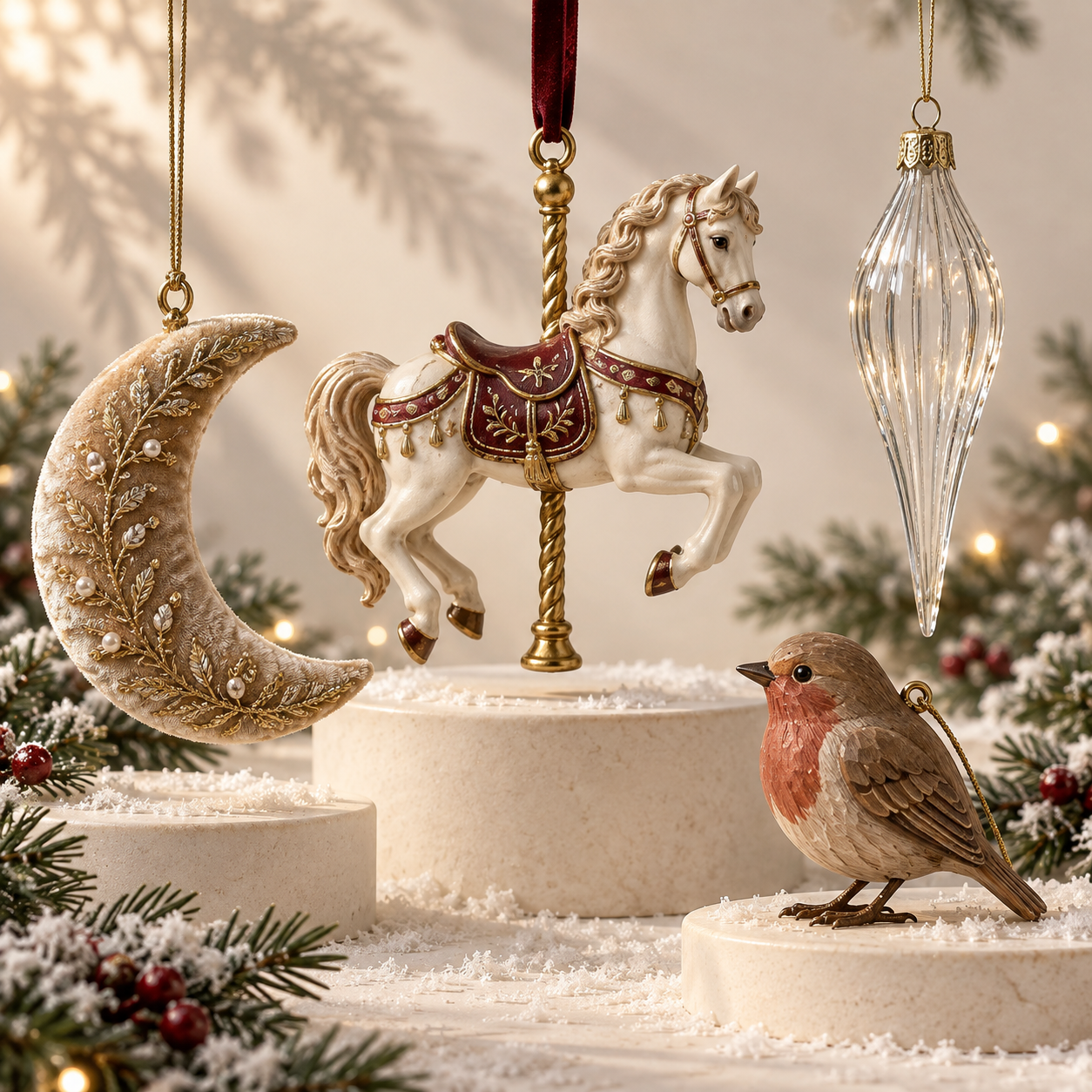
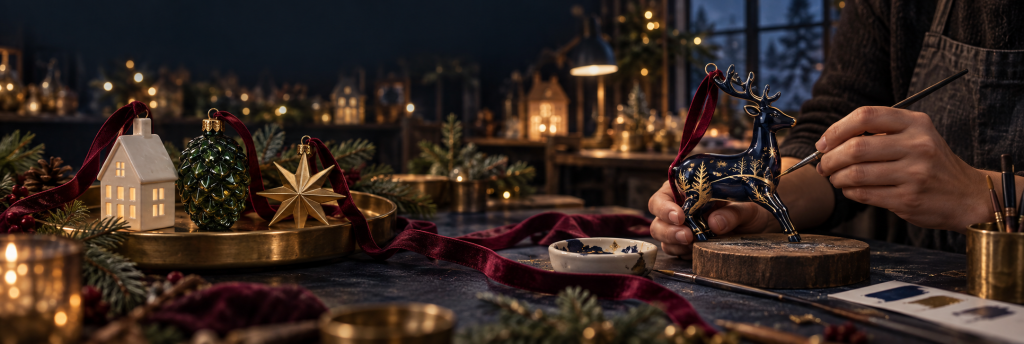
If you are sourcing Christmas decorations for a retail chain, wholesale business or private-label brand, you will probably encounter two terms very quickly:
OEM and ODM.
Both can involve customized Christmas products, but they describe different product-development relationships between the buyer and manufacturer.
Understanding the difference matters because the model you choose can affect:
- Product exclusivity
- Development cost
- Sampling time
- MOQ
- Tooling
- Design responsibility
- Production lead time
- Packaging
- Intellectual property
- Speed to market
For many Christmas decoration programs, the choice is not simply “OEM or ODM.”
The right solution often depends on how much of the product has already been developed, how much customization the buyer needs and how quickly the collection must reach the market.If you want to understand what happens after a custom project begins, see how custom Christmas ornaments are made from design to bulk production.
This guide explains the practical difference between OEM and ODM Christmas decorations from a B2B buyer’s perspective.
What Does OEM Mean in Christmas Decoration Manufacturing?
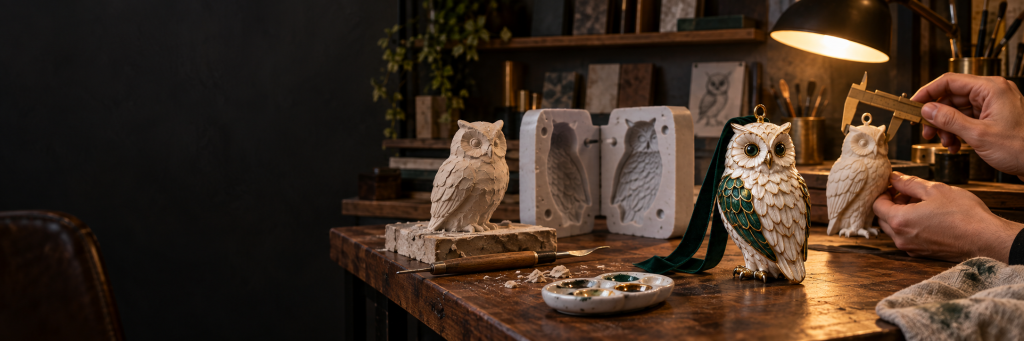
OEM stands for Original Equipment Manufacturer.
In a typical OEM Christmas decoration project, the buyer already owns or controls much of the product concept.
The buyer may provide:
- Original artwork
- Product drawings
- Reference samples
- Dimensions
- Color specifications
- Construction requirements
- Branding
- Packaging requirements
The manufacturer’s role is to review the design, develop a workable sample and manufacture the product according to the approved specifications.
For example, a retailer may develop an exclusive Christmas bird collection with its own colors, shapes, feather details and packaging.
The manufacturer then converts that design into something that can be produced consistently at commercial scale.
OEM is therefore especially useful when the buyer wants a product that is clearly differentiated from standard catalog items.
What Does ODM Mean in Christmas Decoration Manufacturing?
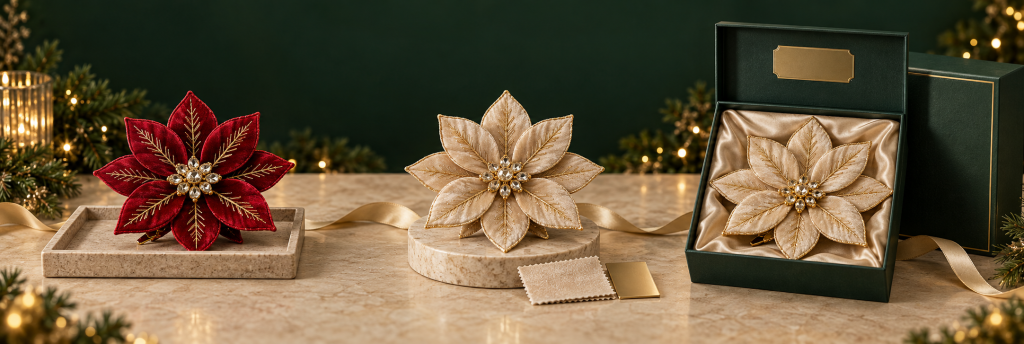
ODM stands for Original Design Manufacturer.
In an ODM project, the manufacturer normally contributes more of the original product design or provides an existing design platform that the buyer can adapt.
Customization may include:
- Colors
- Finishes
- Materials
- Decorative details
- Size
- Assortment
- Branding
- Hangtags
- Retail packaging
For example, a manufacturer may already have a collection of Christmas deer ornaments.
A buyer might select several existing shapes and modify:
- The color palette
- Glitter finish
- Ribbon
- Packaging
- Branding
The underlying product construction remains largely unchanged.
This can reduce the amount of development required before production.
OEM vs ODM Christmas Decorations: Quick Comparison
| Factor | OEM | ODM |
|---|---|---|
| Starting Point | Buyer-developed concept or specification | Manufacturer design or existing product platform |
| Product Originality | Usually higher | Usually based partly on existing development |
| Buyer Design Input | High | Moderate |
| Development Work | Usually greater | Usually lower |
| Sampling Complexity | Often higher | Often faster |
| Tooling Requirement | May be required | Often existing tooling can be used |
| Development Cost | Potentially higher | Often lower |
| MOQ | Can be higher for fully custom products | May be more flexible for existing designs |
| Lead Time | Usually longer | Often shorter |
| Private Label | Yes | Yes |
| Custom Packaging | Yes | Yes |
| Best For | Exclusive product programs | Faster collection development |
This table is a useful starting point, but actual requirements depend on the product.
A simple color change to an existing Christmas ornament is very different from developing a completely new shape requiring tooling and multiple sample revisions.
1. Choose OEM When Product Exclusivity Is Important
OEM is usually the stronger option when a buyer wants to create something that is genuinely different from standard market offerings.
This may apply to:
- Retail-exclusive collections
- Brand signature ornaments
- Licensed designs
- Original characters
- Custom shapes
- Proprietary surface patterns
- Unique coordinated collections
For example, suppose your design team has created a woodland Christmas range featuring:
- A specific deer shape
- Matching birds
- Coordinated flowers
- Custom champagne finishes
- Exclusive packaging
If you want the physical products to closely follow your original designs, an OEM development process makes sense.
The manufacturer should help translate the creative concept into production specifications without unnecessarily changing the design identity.
2. Choose ODM When Speed to Market Matters More
Not every buyer needs to develop a completely new product from zero.
Sometimes the priority is:
Build a differentiated collection quickly.
ODM can be useful when:
- The selling season is approaching
- The buyer is testing a new category
- Development budget is limited
- Order quantities are smaller
- Existing product structures already meet the requirement
For example, you may select an existing Christmas flower design and customize:
- Color
- Glitter
- Clip
- Branding
- Packaging
This can be much faster than redesigning the entire ornament.
Current B2B seasonal-decoration suppliers commonly position ODM around existing designs that can be adapted for branding, colors or collection needs, while OEM programs involve deeper custom development.
3. OEM Usually Requires a Better Product Brief
OEM programs depend heavily on the quality of the information supplied at the beginning.
A useful OEM brief should include:
Product Concept
What are you trying to create?
Reference Images
What visual direction should the manufacturer follow?
Dimensions
What size or size range is required?
Materials
Are any materials mandatory or prohibited?
Colors
Provide Pantone references or physical standards where needed.
Quantity
What is the expected quantity per SKU?
Target Price
If you have one, share a realistic target range.
Target Market
Where will the product be sold?
Packaging
Does the product need retail-ready packaging?
Delivery Window
When does the merchandise need to arrive?
A strong brief reduces guesswork during sampling.
Recent seasonal-decoration sourcing guidance from Ever Fly similarly recommends connecting the creative brief with commercial information such as market, target price, expected quantity, launch timing and packaging rather than sending only a visual reference.
4. ODM Still Requires Clear Customization Limits
ODM may start with an existing design, but the buyer still needs to define what should change.
A good ODM request may look like:
We would like to use your existing 18 cm Christmas bird design, but change the body color to champagne, replace the red feather tail with ivory, add gold glitter details and use our private-label hangtag.
That is much clearer than:
Please customize this product for us.
Before sampling, confirm whether you want to change:
- Color
- Material
- Size
- Surface finish
- Decorative accessories
- Logo
- Label
- Packaging
- Set configuration
Different levels of modification may affect MOQ, price and sampling time.
5. MOQ Can Be Different for OEM and ODM
There is no universal MOQ rule.
However, fully custom OEM products often involve higher setup requirements because the factory may need to source special materials, develop new tooling or organize additional manual processes.
ODM projects may sometimes support more flexible quantities when they use:
- Existing molds
- Existing materials
- Existing constructions
- Standard manufacturing processes
Consider two examples.
ODM Example
Existing Christmas ball design:
- Existing mold
- Different glitter color
- Custom hangtag
- Standard box
This may require relatively little production setup.
OEM Example
Completely new ornament:
- New shape
- New tooling
- Custom hand painting
- Multiple accessories
- Custom molded packaging insert
The minimum viable production quantity may naturally be higher.
Buyers should therefore ask:
“What drives the MOQ for this particular design?”
rather than comparing MOQ numbers without context.
6. Tooling Is More Important in OEM Projects
Some Christmas decorations require new molds, dies, cutting patterns or other production tools.
If new tooling is required, buyers should clarify:
- Tooling cost
- Who pays for it
- Who owns it
- Where it is stored
- Whether it can be reused
- Whether another customer can use the same tooling
These questions are particularly important when the physical shape is intended to be exclusive.
A buyer should not assume that paying a development fee automatically establishes exclusive tooling ownership.
Commercial terms should be documented clearly.
7. Sample Development Is Usually More Complex for OEM
OEM samples may move through several stages.
For example:
Buyer Drawing
↓
Factory Feasibility Review
↓
Prototype
↓
Buyer Feedback
↓
Revision
↓
Approved Sample
ODM development can sometimes be simpler:
Existing Product
↓
Requested Modification
↓
Modified Sample
↓
Approval
Neither process is automatically better.
The important point is that the sampling route should match the amount of product development required.
A fully custom product should not be treated as if it were a simple color-change project.
8. Design Responsibility Should Be Clear
One common source of confusion is assuming that “OEM” means the factory will automatically design everything.
That is not necessarily true.
In a traditional OEM relationship, the buyer often provides much of the original product direction.
The manufacturer contributes manufacturing engineering and production knowledge.
ODM generally involves greater supplier contribution to the product concept itself.
In real B2B projects, however, the boundary can overlap.
For example:
A buyer may provide:
- Theme
- Mood board
- Color palette
- Retail target
The factory may then propose:
- Product structures
- Materials
- Decorations
- Size
- Manufacturing methods
This project combines elements of both OEM and ODM.
The exact terminology matters less than clearly defining who is responsible for each part of development.
9. Private Label Is Not the Same as OEM
This distinction is important.
Private label generally means the product is sold under the buyer’s brand.
That may involve:
- Buyer logo
- Hangtag
- Barcode
- Branded box
- Printed insert
- Retail label
But a private-label product can still be based on an existing factory design.
For example:
Existing ornament + buyer packaging = Private Label ODM
while:
Buyer-created ornament + buyer packaging = Private Label OEM
So:
Private Label describes branding.
OEM/ODM describes product development and manufacturing.
Buyers often use these terms interchangeably, but separating them helps avoid misunderstanding during quotations.
10. Packaging Can Be Customized Under Both Models
Both OEM and ODM Christmas decoration programs can include customized packaging.
Possible options include:
- Custom hangtags
- Header cards
- Window boxes
- Color boxes
- Gift boxes
- Sets
- Printed inserts
- Barcode labels
- Retailer-specific labels
- Master carton markings
Packaging can sometimes require just as much development as the ornament itself.
For example, a delicate Christmas bird with long feathers may require a protective internal structure.
A hanging ornament set may require dividers.
A premium Christmas ball range may require a window box that presents the finishes clearly without allowing the ornaments to move during transit.
Packaging requirements should therefore be introduced early in both OEM and ODM programs.
11. Consider Intellectual Property Early
For custom product development, intellectual property expectations should be discussed before production.
This is particularly relevant when the buyer provides:
- Original artwork
- Licensed characters
- Original product designs
- Proprietary patterns
- Brand logos
Buyers should clarify who owns the supplied artwork and what the manufacturer is permitted to do with it.
Likewise, if the manufacturer provides an ODM design, the buyer should understand whether:
- The design is sold to multiple buyers
- An exclusive version is available
- Specific modifications can remain exclusive
- Market exclusivity is negotiable
Do not assume exclusivity simply because a product has been customized.
If exclusivity matters commercially, it should be discussed and documented.
12. Compare Development Cost, Not Only Unit Price
When comparing OEM and ODM options, buyers sometimes focus only on finished unit cost.
However, the total product-development budget may include:
- Sample fees
- Tooling
- Special materials
- Artwork preparation
- Custom packaging
- Testing
- Additional sample rounds
OEM development may require greater upfront investment but create stronger product differentiation.
ODM may reduce development expense and allow faster market entry.
Neither is automatically cheaper in every situation.
The better question is:
Which development model creates the best commercial result for this particular collection?
13. Lead Time Can Differ Significantly
OEM generally requires more development time because more decisions need to be made before production.
A fully customized project may include:
Design Review
↓
Material Selection
↓
Tooling
↓
Sample Development
↓
Revision
↓
Final Approval
↓
Packaging Development
↓
Production
ODM can often remove some of these stages by starting with an existing product platform.
This distinction is particularly important in Christmas merchandise because the retail selling window is fixed.
A product delivered after the season has much less commercial value, regardless of how good the design is.
14. Which Model Is Better for New Product Testing?
ODM can often be useful when a buyer wants to test:
- A new category
- A new market
- A new retail channel
- A new price point
- A new color story
The buyer can customize an established product without committing to the cost and time required for a completely new development.
If the collection performs well, later seasons can move toward deeper OEM customization.
This can create a practical development path:
Season 1 — ODM / Market Test
↓
Season 2 — Expanded Customization
↓
Season 3 — Exclusive OEM Collection
This is not a fixed rule, but it can be a useful approach for buyers managing product-development risk.
15. Which Model Is Better for Established Brands?
Established brands often use OEM when they want:
- Strong visual differentiation
- Proprietary collections
- Signature product shapes
- Exclusive design language
- Closer control over specifications
For products such as Christmas ball ornaments, ODM development may begin with an existing size and construction while changing color, finish, assortment and retail packaging.
However, large brands also use ODM strategically.
For example, core or entry-level products may use existing factory platforms while premium hero products receive more custom development.
A collection may therefore contain both:
ODM volume SKUs
and
OEM hero SKUs
The sourcing strategy can be decided SKU by SKU rather than applying one model to the entire assortment.
OEM or ODM? A Practical Decision Checklist
Choose OEM if most of these statements apply:
- We already have our own design.
- Product exclusivity matters.
- We need a unique shape or structure.
- We can allow more development time.
- We accept possible tooling costs.
- We expect meaningful production volume.
- Our brand requires strong differentiation.
Choose ODM if most of these statements apply:
- We want to begin from existing designs.
- We mainly need color or finish changes.
- We want faster sampling.
- We are testing a new category.
- Development budget is limited.
- Lower complexity is important.
- Speed to market is a priority.
For many buyers, the best solution sits somewhere between the two.
OEM vs ODM Example: Christmas Bird Collection
Imagine a retailer wants to launch a champagne-colored Christmas bird collection.
ODM Route
The buyer selects an existing bird design.
Changes:
- Champagne body
- Gold glitter
- Ivory feather
- Buyer hangtag
- Custom window box
The product structure remains largely unchanged.
OEM Route
The buyer supplies an original bird illustration.
The manufacturer develops:
- New body proportions
- Custom wing structure
- Special feather arrangement
- Exclusive glitter pattern
- Buyer-specific clip
- New packaging insert
This route involves more development but creates a more distinctive product.
Neither route is inherently superior.
They serve different commercial objectives.
How REINDEER Supports Custom Christmas Decoration Development
REINDEER has manufactured Christmas decorations since 1998.
Our approximately 20,000 sq. ft. manufacturing facility combines traditional handcraftsmanship with organized production methods, with more than 200 skilled artisans supporting production during peak periods.
Depending on the project, buyers may begin with:
- Their own drawings
- Reference photographs
- Mood boards
- Existing products
- Color directions
- Product ideas
- Our current designs
We can then evaluate:
- Materials
- Construction
- Finishing
- Handwork
- Sample feasibility
- Packaging
- Production requirements
Some programs are closer to traditional OEM.
Others begin from existing designs and follow an ODM-style development route.
Our priority is not the label applied to the project.
It is to establish a clear development path before bulk manufacturing begins.
For a B2B buyer, the key questions should always be:
What is already defined?
What still needs to be developed?
Who is responsible for each decision?
When those questions are answered clearly, sampling and mass production become much easier to manage.
Frequently Asked Questions
What is the difference between OEM and ODM Christmas decorations?
OEM normally means the manufacturer produces a product based largely on the buyer’s design or specifications. ODM normally begins with a manufacturer-developed design or product platform that the buyer can customize. In practice, some projects combine elements of both.
Is OEM better than ODM?
Neither is automatically better. OEM is generally more suitable when product exclusivity and deep customization are important. ODM can be more suitable when buyers want faster development, lower complexity or an existing product platform.
Can I add my brand to an ODM Christmas ornament?
Yes. ODM products can often include private-label elements such as logos, hangtags, barcodes and custom retail packaging, depending on the supplier and product.
Does OEM require a higher MOQ?
Not always, but fully customized products may require higher minimum quantities when special materials, new tooling or complex production setup are involved.
Can an ODM product be exclusive to my company?
Possibly, but exclusivity should never be assumed. Buyers should discuss whether the underlying design, specific modifications or particular markets can be made exclusive and document any agreement clearly.
Who owns an OEM Christmas ornament design?
Ownership depends on the commercial agreement and the source of the design. Buyers should clarify ownership of artwork, tooling and product designs before development when exclusivity is important.
Is private label the same as OEM?
No. Private label refers mainly to the branding under which the product is sold. A private-label product can be either OEM or ODM.
Which option is faster, OEM or ODM?
ODM is often faster because development can begin from an existing design or construction. Fully custom OEM projects may require additional feasibility review, tooling, sampling and revisions.
Can I use both OEM and ODM products in the same Christmas collection?
Yes. A buyer may use ODM products for standard or volume items and OEM development for exclusive hero products within the same seasonal range.
Final Thoughts
The difference between OEM and ODM Christmas decorations is not simply industry terminology.
It affects how your product is developed, how much creative control you have, how long sampling may take and how much development work is required before mass production.
In simple terms:
OEM = your product concept, developed for manufacturing
ODM = an existing manufacturer concept, adapted for your market
But real sourcing projects often fall somewhere between those definitions.
For B2B buyers, the most important step is to define the project clearly before requesting a quotation.
If you are developing a new Christmas decoration collection, send REINDEER your reference images, approximate quantity, customization requirements, target market, packaging needs and delivery window.
We can review whether your project is better suited to an OEM-style custom development route, an ODM-style modification route or a combination of both.