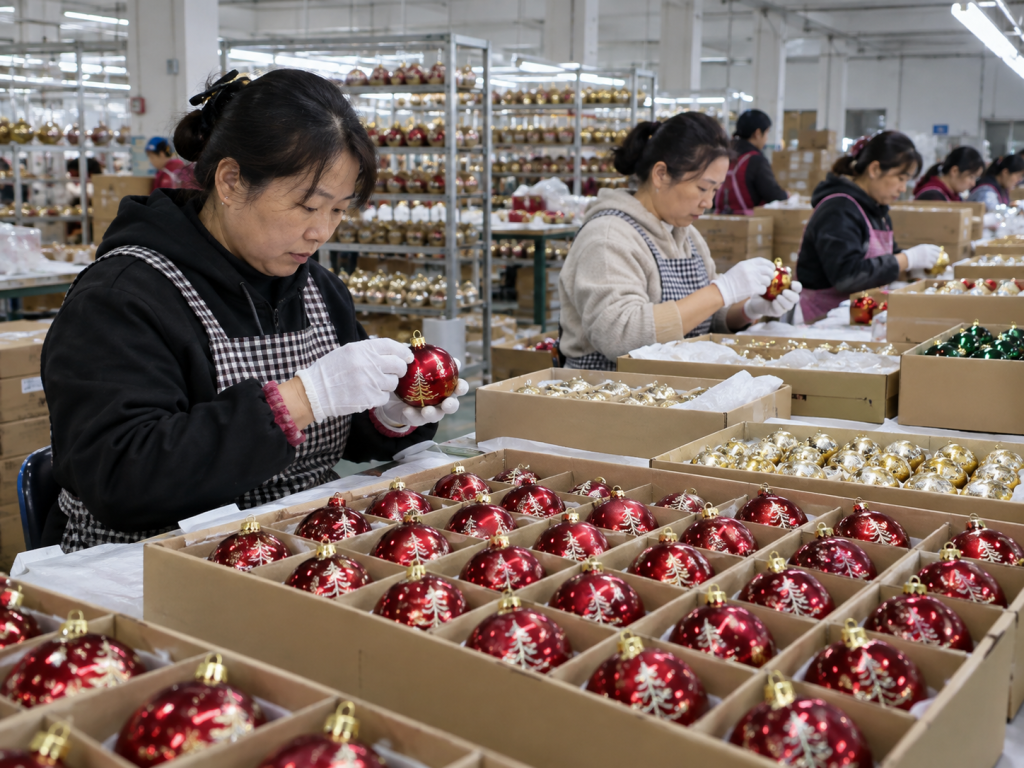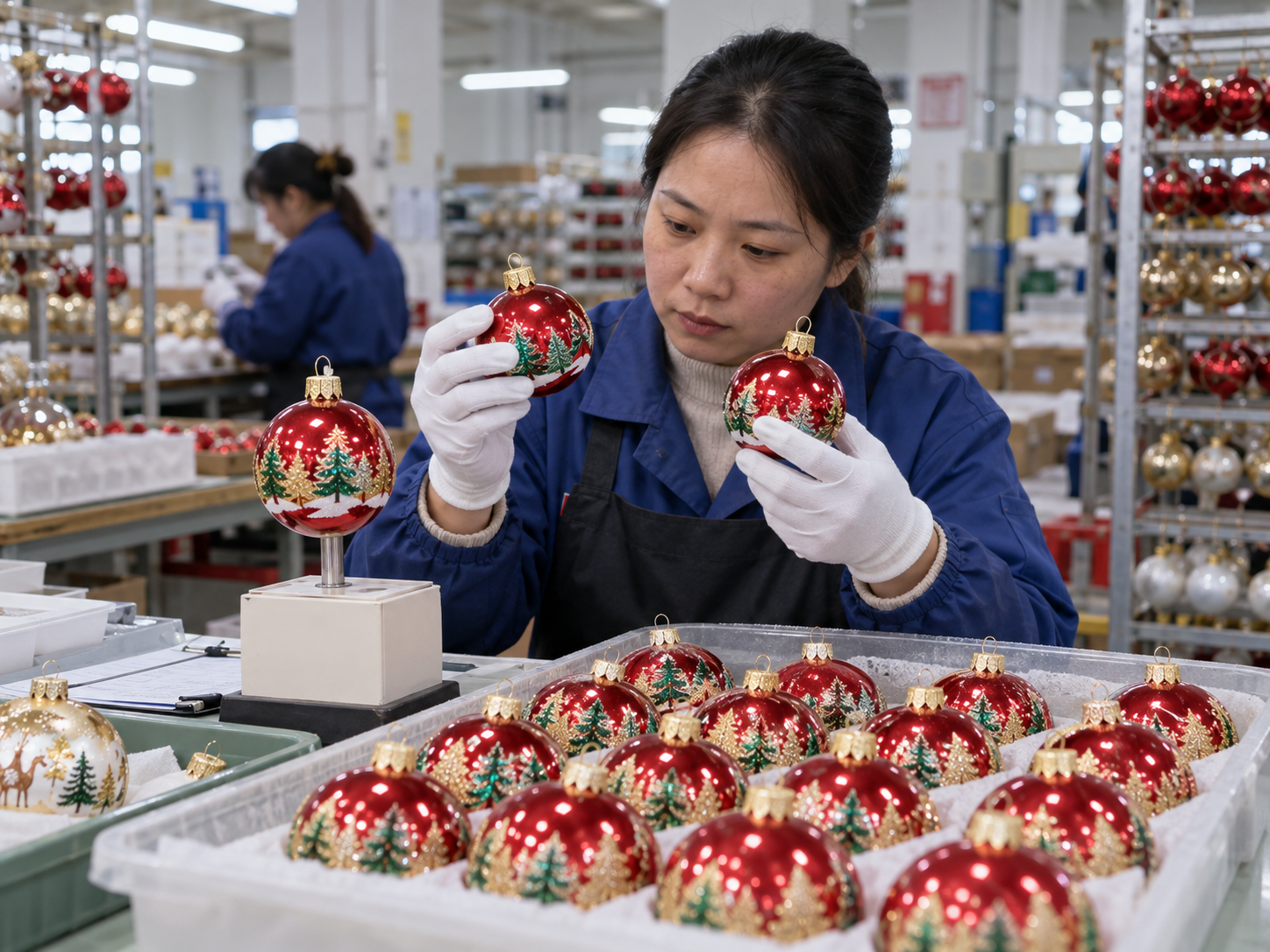
Christmas ornaments are highly visual products. A small difference in color, glitter coverage, painting, assembly or packaging may be immediately noticeable when dozens of pieces are displayed together in a retail collection.
That makes quality control especially important for importers, wholesalers, retailers and private-label brands.
The objective of Christmas ornament quality control is not simply to inspect finished products before shipment. A stronger approach establishes the quality standard during sample approval and then checks production against that standard throughout manufacturing.
For most B2B orders, the process should answer three questions:
Does the bulk product match what was approved?
Is the ornament properly assembled and suitable for its intended display method?
Will the product arrive in acceptable condition after packing and transportation?
This checklist explains what buyers should review from sample approval through final inspection.
1. Start With an Approved Sample
Quality control becomes difficult when there is no clear reference standard.custom Christmas ornaments are made
Before bulk production, buyers and manufacturers should agree on an approved sample or documented specification covering the important characteristics of the product.
These may include dimensions, material, color, surface finish, decorative placement, artwork, accessories, hanging components and packaging.
For products involving substantial handwork, the approved sample should represent the intended visual standard rather than imply that every handmade detail must be mathematically identical.
For example, hand-applied glitter or painted details may naturally show small variations. The important question is whether those variations remain within an acceptable range for the collection.
A factory should not have to guess what the buyer considers acceptable after mass production has already started.
2. Confirm Color and Finish Consistency
Color problems are among the easiest defects for a retail customer to notice.
When a collection includes champagne, gold, burgundy, silver or other specific color directions, the factory should compare production against the approved reference.
Depending on the ornament, inspectors may need to review paint color, fabric color, glitter tone, metallic finish, flocking, ribbons or feathers.
Lighting also matters. Products that appear similar under poor factory lighting may look noticeably different when displayed together in a bright retail environment.
Where exact color is commercially important, buyers should provide a clearly identified reference such as an approved physical sample, material swatch or recognized color reference.
Surface finish should be checked at the same time.
A matte product should not contain unexpected glossy areas. Glitter coverage should remain visually consistent. Metallic finishes should not show obvious uneven patches unless variation is part of the intended design.
The objective is consistency across the assortment rather than simply checking one individual unit.
3. Inspect Painting, Glitter and Decorative Details
Many Christmas ornaments rely heavily on surface decoration.
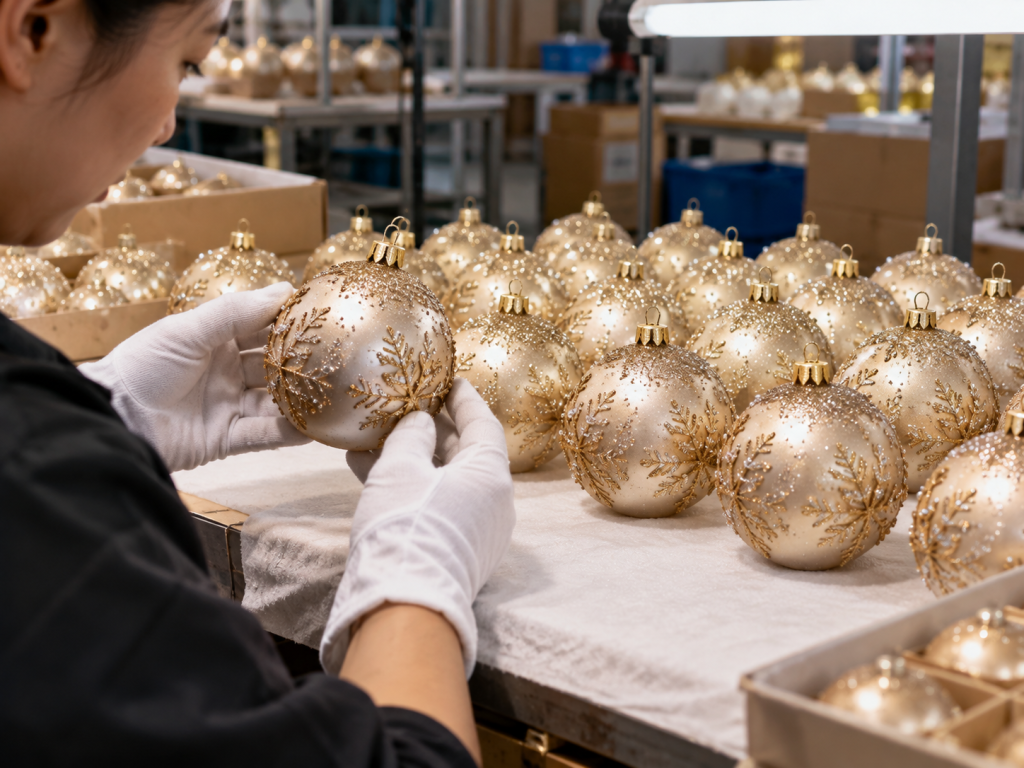
For hand-finished products, inspectors should compare the overall appearance with the approved sample and pay particular attention to repeated defects.
Typical concerns include incomplete painting, excessive paint, obvious brush errors, inconsistent glitter coverage, visible adhesive, missing beads, misplaced sequins or decorations attached at noticeably different angles.
One slightly different handmade detail may be acceptable.
The same problem appearing repeatedly across a production lot is different because it may indicate a process issue.
This is one reason in-process inspection is valuable. If decorative positioning begins drifting away from the approved standard, production can be corrected before thousands of pieces are completed.
4. Check Product Dimensions and Proportions
Measurements should be confirmed when size matters to packaging, retail display or a coordinated collection.
For example, buyers may need to verify overall height, width, ornament diameter, hanging length or the size of specific decorative components.
Small measurement variation may be normal for handmade products, but the acceptable tolerance should be agreed before inspection.
Dimensions can also reveal production problems that are not immediately obvious.
If a decorative bird becomes significantly heavier or larger than the approved sample, it may no longer hang correctly.
If a tree topper attachment is too small or incorrectly positioned, the product may look good in a carton but fail in actual use.
Inspection should therefore consider both dimensions and how those dimensions affect the product’s intended function.
5. Inspect Assembly and Attachment Points
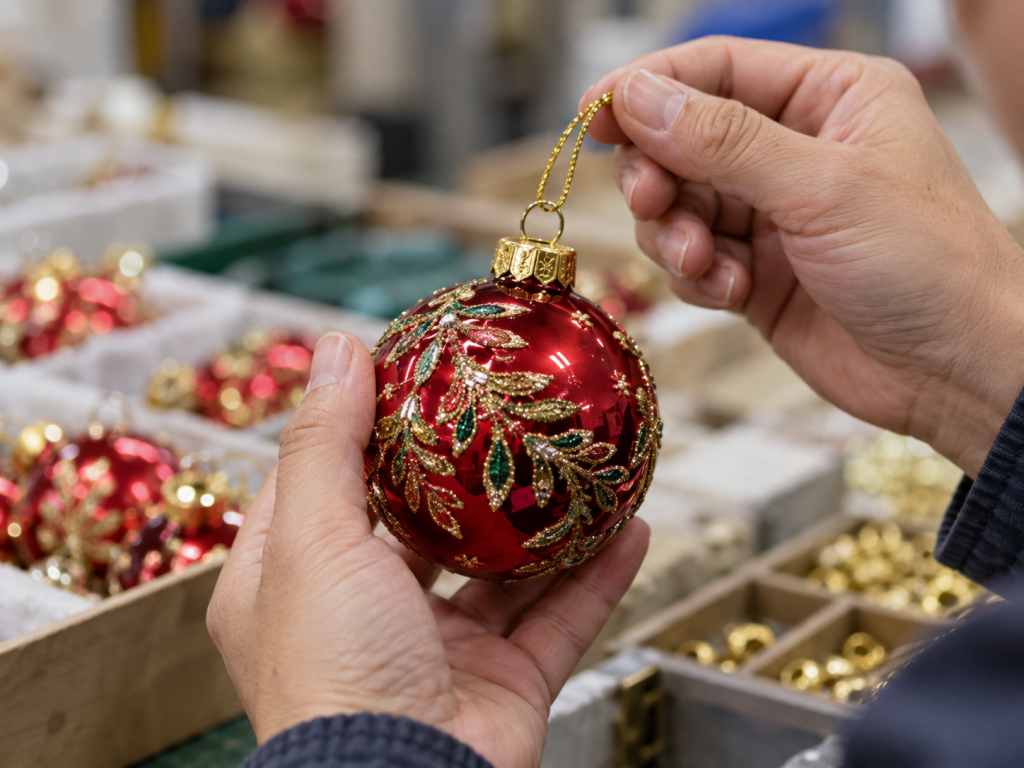
Decorative ornaments often consist of multiple parts.
These can include wings, antlers, flowers, ribbons, clips, caps, hanging cords, wires, beads, feathers and other accessories.
Quality control should confirm that these parts are positioned correctly and securely attached.
For hanging products, inspect the connection between the ornament and hanging cord or cap.
For clip-on decorations, confirm that the clip is properly positioned and holds the product as intended.
For tree toppers or standing decorations, check whether the finished product remains properly balanced.
The inspection should reflect how a customer will actually use the item rather than only how the ornament looks while lying on an inspection table.
6. Identify Cosmetic Defects Before Packing
Cosmetic appearance is particularly important for seasonal décor because customers often buy these products primarily for visual appeal.
Finished products should be checked for noticeable scratches, stains, adhesive residue, fingerprints, damaged glitter, deformed components, broken decorations or other visible issues.
Inspection standards should consider the normal viewing distance and retail presentation.
A tiny mark hidden underneath a product may have a different commercial impact from a scratch across the front of a glossy Christmas ball.
For this reason, buyers should define defects based on actual product expectations rather than treating every imperfection as equally important.
7. Separate Critical, Major and Minor Defects
For larger wholesale orders, it is useful to classify problems by severity.
A critical defect would involve a serious safety or regulatory concern appropriate to the product.
A major defect may make the item unsuitable for sale or cause a significant difference from the approved specification.
A minor defect may be a smaller cosmetic variation that does not prevent normal sale or use.
The exact definitions should be agreed for the specific ornament.
For example, a missing major decorative component would normally be treated more seriously than a very small variation in hand-applied glitter.
This classification also makes inspection results easier for buyers and factories to discuss objectively.
8. Use a Defined Sampling and Acceptance Method
Large orders are not always inspected by checking every single item.
Many buyers use statistical sampling to select units from the production lot and then compare the number and severity of defects against an agreed acceptance standard.
The important point is to define the inspection method before the inspector arrives.
The purchase agreement or inspection instruction should make clear which sampling method is being used, how defects are classified and what acceptance criteria apply.
AQL, or Acceptance Quality Limit, is commonly discussed in B2B inspections, but there is no single AQL value that should automatically be applied to every Christmas decoration order.
The appropriate inspection plan depends on the buyer’s requirements, product risk, customer standards and commercial agreement.
For important retail programs, buyers may define their own inspection manual or appoint an independent inspection company to perform the final check.
reliable Christmas ornament manufacturer
9. Check Retail Packaging Together With the Product
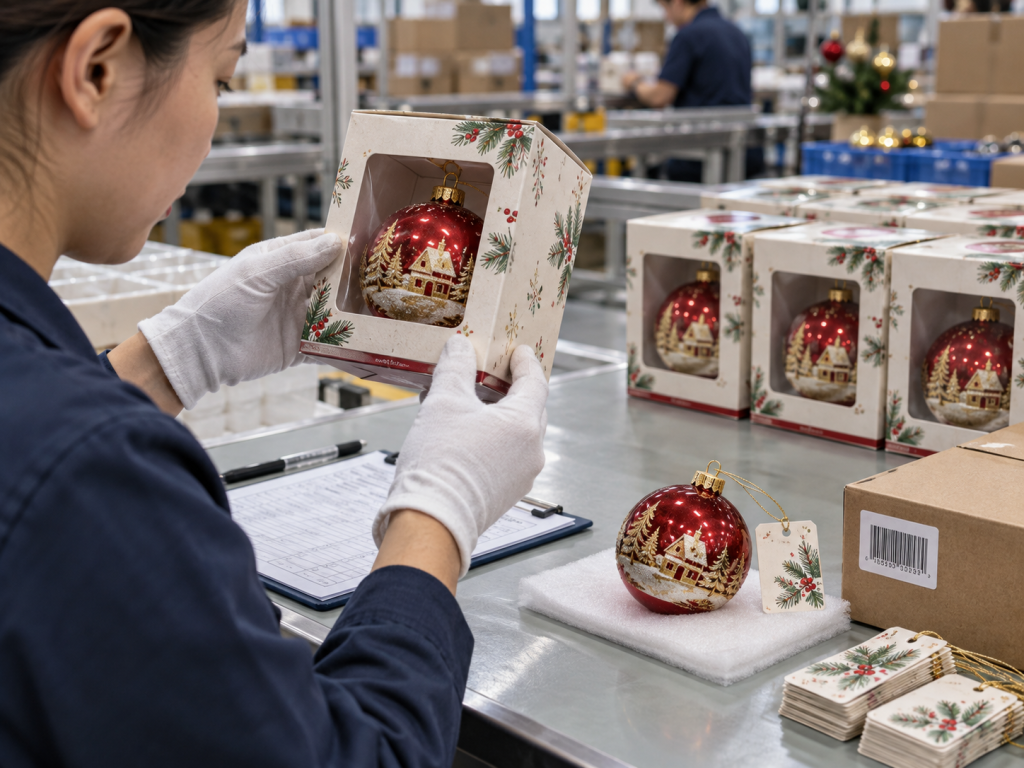
An ornament can pass product inspection and still fail commercially because of poor packaging.
Inspectors should verify that the correct product is packed in the correct packaging and that labels, barcodes, artwork and quantities match the approved specification.
The ornament should also fit correctly inside its package.
Look for situations where decorative components are being compressed, glitter surfaces are rubbing against the box or feathers are being bent during packing.
For sets, check that the correct assortment and quantity are included.
For private-label programs, confirm branding and barcode information before large quantities are packed. Correcting a packaging error after thousands of units have been completed can be much more expensive than identifying it during early production.
10. Inspect Export Cartons and Product Protection
Retail packaging is only one layer of protection.
The final shipment also needs to withstand handling, stacking and international transportation.
Inspect master cartons for correct dimensions, carton markings, quantities and general condition.
Where appropriate, confirm that internal dividers, protective wrapping or inserts are being used as approved.
Products should not have excessive movement inside the carton.
For delicate or irregularly shaped ornaments, buyers may also want packaging validation earlier in the development process instead of waiting until final inspection.
This is particularly important for items with fragile finishes, projecting decorations, feathers or easily deformed components.
11. Perform Final Inspection Before Shipment
Final inspection should take place when enough of the order has been completed and packed to provide a meaningful picture of production quality.
The inspector should have access to the approved sample, specifications, packaging requirements and purchase-order information.
The final report should make it easy for the buyer to understand whether the inspected lot meets the agreed requirements.
If defects are discovered, buyers should evaluate both quantity and pattern.
A few unrelated minor issues may indicate something very different from the same major defect repeatedly appearing throughout the sample.
When corrective action is required, the factory and buyer should agree on what will be reworked and whether a reinspection is necessary before shipment.
Christmas Ornament QC Checklist
| Inspection Area | What to Check |
|---|---|
| Approved Standard | Correct sample and specifications are available |
| Color | Matches approved color direction |
| Finish | Matte, glossy, metallic, glitter or other finish is consistent |
| Decoration | Painting, glitter, beads and accessories are correctly applied |
| Dimensions | Size and proportions meet agreed tolerance |
| Assembly | Attached parts are correctly positioned and secure |
| Display Function | Hanging, clipping, standing or mounting works as intended |
| Appearance | No unacceptable scratches, stains, glue marks or deformation |
| Branding | Correct logo, artwork, labels and barcode |
| Retail Packaging | Correct item, fit, quantity and protection |
| Export Packing | Correct carton quantity, markings and internal protection |
| Final Quantity | Shipment quantity agrees with order requirements |
A Practical Approach for Handcrafted Christmas Ornaments
Quality control for handcrafted décor requires balance.
The purpose of hand finishing is often to create visual character that cannot be reproduced exactly by fully automated manufacturing.
Buyers therefore need to distinguish between natural handcrafted variation and unacceptable inconsistency.
For example, slight differences in individual glitter particles may be acceptable.
A completely different glitter density from one carton to another may not be.
A hand-painted line may vary slightly.
A missing painted feature should not.
The approved sample and written acceptance criteria should make this distinction clear before bulk production begins.
How REINDEER Approaches Production Quality
REINDEER has manufactured Christmas decorations since 1998, combining skilled handcraftsmanship with organized production methods.
Because many of our products involve processes such as painting, glitter application, assembly, stringing and decorative finishing, quality control cannot depend only on one inspection at the end.
The more effective approach is to establish the product standard during sample approval and then compare production against that standard throughout manufacturing and packaging.
For B2B buyers, this helps identify problems earlier and reduces the risk of discovering repeated defects after the complete order has already been packed.
When starting a custom project, buyers should therefore provide clear product specifications and identify any appearance, packaging or retailer requirements that are particularly important to their program.
Frequently Asked Questions
What should be checked during Christmas ornament inspection?
The inspection should normally cover appearance, color, finish, dimensions, decorative details, assembly, hanging or display components, branding, retail packaging and export cartons according to the agreed product specification.
What is AQL in Christmas ornament inspection?
AQL is used in acceptance-sampling systems to help determine whether a sampled production lot meets agreed acceptance criteria. Buyers should define the sampling plan, defect classifications and acceptance requirements for their specific order rather than assume one universal AQL applies to every product.
Should every Christmas ornament be inspected?
Not necessarily. Depending on the buyer’s requirements and product risk, inspection may use statistical sampling rather than 100% checking. Some critical characteristics or higher-risk products may require different controls.
How should handmade variations be handled?
The buyer and manufacturer should agree during sample approval which variations are acceptable characteristics of handcrafted production and which are considered defects.
When should final inspection take place?
Final inspection is generally performed when production and packing have progressed far enough for the sample to represent the shipment accurately, but before the goods are released for shipment.
Final Thoughts
Effective Christmas ornament quality control begins before final inspection.
The strongest process is:
Approved Sample → In-Process Checks → Final Inspection → Packaging Verification → Shipment Approval
For importers and retailers, a clear approved sample and written inspection criteria are more useful than vague instructions such as “good quality.”
If you are developing a custom or wholesale Christmas ornament collection, REINDEER can review your product specifications, sample requirements and packaging expectations before bulk production begins.